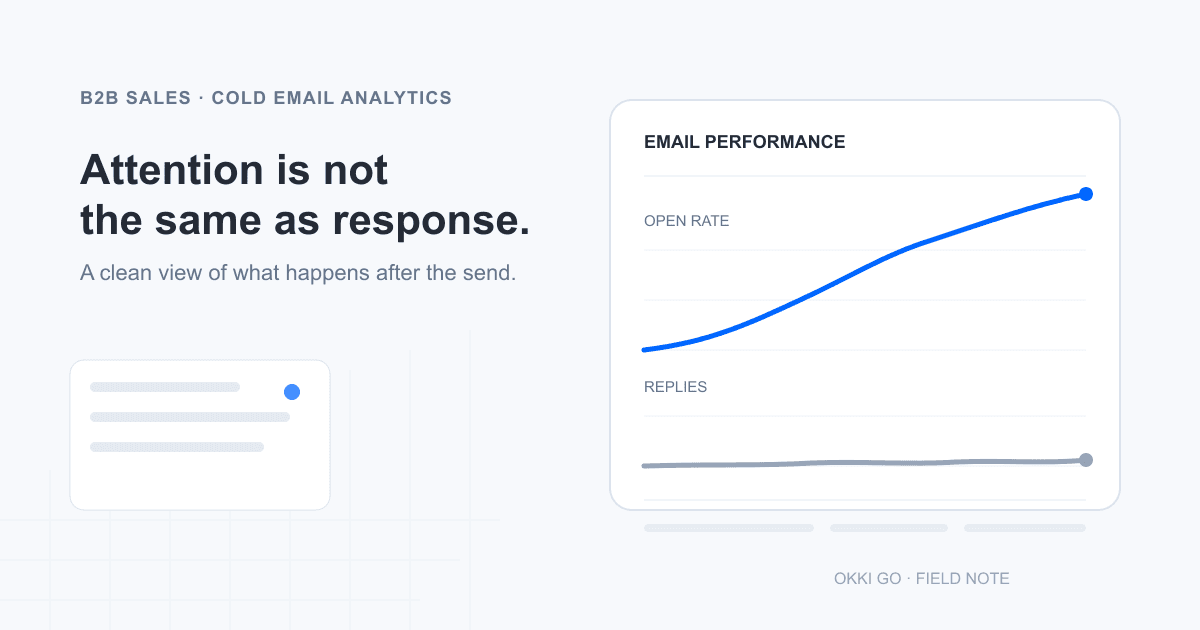
Why does the list look fine, the email seem reasonable, and yet almost nobody replies? When this happens, an outbound team will usually start with the copy. They change the subject line, rewrite the opening, and try a more direct CTA. If that does not help, they add more follow-ups. Those changes can sometimes solve the problem. Quite often, though, the real issue sits before the copy.
Start with a more basic question: is the person this email is being sent to actually dealing with the problem it mentions? A company that fits your criteria is only a potential account. You still need to know whether the contact is right and whether the problem is worth their time right now. If the company, contact, problem, or timing is out of alignment, the email can look relevant and still receive very few useful replies.
A list is more than a company name
Many lists stop at the company level. The industry fits, the location fits, and the company size fits, so the account is added to the outbound sequence. But the email is going to a specific person. Their department, responsibilities, and current priorities often matter more than the company’s industry label when it comes to whether the conversation can go anywhere.
You may have found the right company and still chosen the wrong person. The contact may sit in another department, lack the authority to move the issue forward, or know that the problem exists without being responsible for solving it. Sometimes the contact is in a relevant role, but the issue is not near the top of their workload. The database may look complete. The gap becomes obvious when the account turns into an actual email.
A list that is ready for outreach should make three things clear enough to explain: why the company might care about the problem, why this person might be involved, and why there is a reasonable reason to contact them now.
If you can answer only the first question, you just have a list of companies. You do not yet have a group of people you can confidently email.
An offer is NOT another way to describe the product
In a cold email, the offer is the reason for this specific conversation. It should help the recipient understand why they are receiving the email, why the problem may relate to their work, and what they would need to do first if they decided to reply.
“We help companies improve sales efficiency” may be true, but the recipient still does not know why they should care now or what the statement has to do with their work. That kind of message is closer to a product introduction. It has not yet become an offer that can open a conversation.
A clear offer does not need to explain every part of the value in one email. It needs to narrow the problem to something the recipient can judge and suggest a first step that does not require much effort. The recipient can first confirm whether the issue belongs to their team or decide whether it is worth exploring further.
That is why the list and the offer need to be considered together. The list determines who you are speaking to. The offer gives that person a reason to respond. If they are not addressing the same problem, a more specific email will only make the mismatch easier to see.
Find the mismatch before changing the copy
A low reply rate does not necessarily mean the email is poorly written. The company may be right while the contact is wrong, so the message stops at the contact. The contact may be relevant while the problem has no current priority, so the recipient understands the email but has no reason to respond now. The problem may be valid while the offer is too broad, leaving the reader with a message that makes sense to everyone but feels directly relevant to no one.
There is another version of the same problem. The offer is broadly on the right track, but the first request to work together is too heavy. Before both sides have even established that the problem exists, the email asks for a meeting, a product evaluation, or an internal introduction. Even an interested recipient may put it aside for later.
All of these situations can end with the same result: a weak reply rate. The right adjustment is different in each case. Another subject-line change can address only a small part of the problem.
Take a sample of real target accounts and contacts. For each one, write down why the company might care about the problem, why the person might be involved, and why replying now would make sense for them.
You do not need a complicated scoring model or a precise-looking number for every contact. The reasoning is enough. If the first answer is unclear, the account segment may be too broad. If the second is unclear, the contact needs another look. If both are clear but the third answer still feels forced, the problem is more likely to be the offer or the timing.
This check helps separate a list problem from a copy problem. When the list is wrong, more precise copy only helps the team spend more time on the wrong people. When the list and the situation fit but the offer does not, adding more accounts will not make the email more relevant.
Adjust the list and the offer together
If the account segment is too broad, narrow the situation first and then decide which kinds of contacts you need to find. Do not rely on more company names, industry updates, or other personalization to cover up a problem with the target definition.
If the contact’s role is wrong, adjust the contact search. A more attractive CTA cannot turn someone who does not own the issue into the right person. If the problem exists but is not a current priority, revisit the trigger and the timing. The recipient may not reply simply because there is no reason to deal with the issue this week. If the offer is too broad, narrow it to a specific situation and then reconsider who should receive it. When the problem changes, the right contact and the right first request may change with it.
Do not replace the list, sender name, subject line, body, CTA, and follow-up schedule in the same round. Fix one clear mismatch at a time so the next result tells you where the change came from.
The next time a cold email gets very few replies, do not start by asking whether the subject line needs to be more dramatic. First confirm why the company is worth contacting, why this person might be responsible for the problem, and why the offer deserves a response now.
If those three questions still have no clear answer, more copy edits may make the email look more complete. They will not make it more useful.