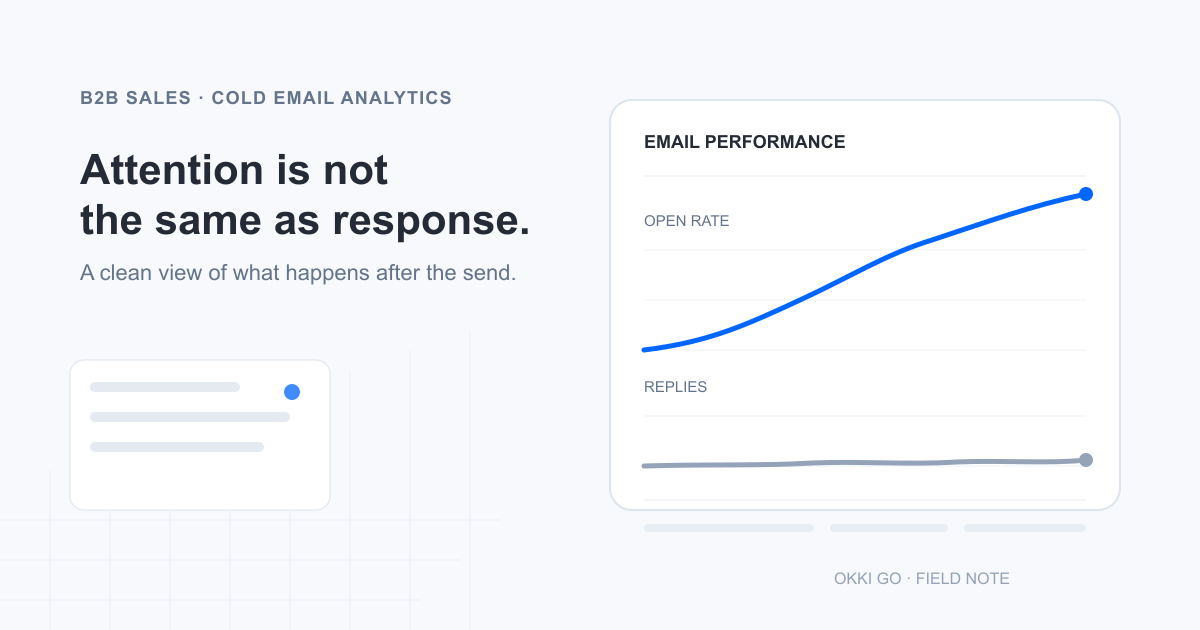
 Cold email reports are easiest to misread when the open rate starts moving in the right direction. The team sees the number go up and assumes the message is finally getting noticed. Then they check the inbox and find that the number of useful replies has barely changed.
Opening an email and replying to it are different actions. An open only suggests that the message may have caught someone’s attention. A reply requires the recipient to understand the point, decide that the issue is relevant, and spend time responding. One part of that process can improve while the next one stays exactly where it was.
The gap between open rate and reply rate is often more useful than the open rate by itself. It tells you that the message stopped somewhere between being seen and getting a response.
What the open rate actually tells you
An open is an event recorded by the mail system. It does not show that the recipient read the message carefully, understood the offer, or considered the problem important enough to act on.
The data is also affected by how email clients handle remote content. Apple’s Mail Privacy Protection can load remote content in the background and prevent senders from knowing whether a recipient opened a message. Google says Gmail does not track open rates and cannot verify the accuracy of open rates reported by third parties. The final article should link this paragraph to the current Apple and Google documentation.
Open rate still has value for comparison. When the sending system, target audience, and other conditions stay broadly the same, a change after a subject-line test is worth looking at. The number is useful for noticing movement. It is not enough to explain the whole campaign or prove that the recipient is interested.
Replies tell you more. A reply may be negative, a redirect, or a request for more information, but it still shows that the recipient made a clear response to the message. Once the open rate has gone up, the more useful question is what failed between being seen and getting a reply.
Find where the email stops making sense
Start with delivery. An open event does not show that every message in the segment reached the primary inbox. Bounces, delivery errors, sender identity, domain health, and the recipient providers in the campaign all affect how the number should be read. If the email is not arriving consistently, changing the copy will not solve the problem.
The contact is the next thing to check. A target company may fit the criteria while the person receiving the email is still the wrong contact. They may work in another department, lack the authority to move the issue forward, or know that the problem exists without being responsible for it. A better subject line cannot fix that mismatch. It only helps the wrong person notice the message sooner.
The personalization deserves another look too. Adding a company name or a recent update may show that you looked at the account, but it does not necessarily make the email relevant to the recipient. Remove the company name and read the message again. If it still works for most of the list, the personalization is probably only surface-level.
The recipient needs a credible reason to believe that the issue may relate to their company, team, or current work. They do not have to agree that the problem exists immediately. They do need to understand why you thought the message was worth sending to them.
The requested action matters as well. Asking for a thirty-minute meeting, a product evaluation, or an internal introduction in the first email usually creates more work than a cold contact is ready to take on. Those actions may make sense later. At the beginning, a smaller question gives the conversation a chance to start. You could ask whether the issue belongs to the recipient’s team, whether a short example would help, or whether someone else should handle it.
The goal is not to make the CTA vague. It is to keep the size of the request in line with the amount of trust that exists.
Follow-ups are part of the same chain. “Just following up” does not give the recipient a new reason to reopen the conversation. A useful follow-up can clarify the original point, add a specific example, narrow the question, or make it easier to pass the message to the right person. It can also acknowledge that the issue may not be a current priority.
If every follow-up adds pressure without adding information, the sequence becomes easier to ignore.
Let the gap decide what to change
When open rate rises and replies stay flat, the subject line or sender name may be getting more attention while the body still fails to explain why the message deserves a response. Before changing the subject line again, read the opening and the final request.
When open rate stays flat and replies fall, move earlier in the chain. Delivery, list structure, and contact segmentation may have changed before the recipient even considered the offer.
When replies increase but qualified replies do not, look at who is responding and what they are asking about. The email may be creating curiosity without giving the recipient a strong enough reason to continue.
When qualified replies increase but meetings do not happen, the problem may have moved beyond the email. Look at scheduling, handoff, and who handles the reply once it arrives.
Before changing the sequence, take a fixed sample of real messages and recipients. Read them from the recipient’s side. Does the contact actually own the problem? Does the opening make the relevance clear? Is the evidence specific? Is the first request reasonable for a new conversation?
Change one part at a time. Do not replace the list, sender name, subject line, body, CTA, and follow-up schedule in the same round. If the result changes, you should still be able to tell what caused the change.
When the campaign is too small for a clean test, read the replies directly. Someone saying “wrong person,” “not a priority,” “already solved,” or “send more details” is not just selecting a response category. They are giving you evidence about what the next round should change.
Keep open rate on the report. It can help the team notice movement, but it should not be asked to explain the entire campaign.
The useful question is not how many people opened the email. It is where the conversation stopped and what the next send should change.