A more relevant message can still be the wrong next action. Decide what would justify sending it.

Table of contents
What should stop the next message?
“We’ve found something more relevant to say.” Is that a good reason to send another email? Sometimes. But imagine a prospect has already replied, “Please remove me from your outreach.” Your agent then finds a new product launch at that company and drafts a polished, specific follow-up. The research may be accurate. The message may be useful to someone else. Neither changes this recipient’s request. This is a fictional example, not a customer incident or a tested model output.
What went wrong? The draft answered a writing question while the decision was about whether contact should continue. Personalization helps you explain why an offer might matter. It cannot decide every question about whether the recipient should receive it. A stop rule names the event that blocks the next scheduled action, the outreach it affects and what, if anything, could make a later action appropriate. Without those boundaries, a writing improvement can quietly become an excuse to keep sending.
This distinction already exists in ordinary sales software. HubSpot’s sequence documentation describes automatic unenrollment when a contact replies with the reply switch enabled, unsubscribes through the sequence link, has a bounced address or completes the sequence. It also makes an important limit explicit: unenrollment stops upcoming scheduled steps; it does not undo messages already sent. These are documented controls in one product, not evidence that every outreach agent detects the same events.
Why decide before improving the copy?
If you only inspect the new draft, you can miss the reason it should never have been queued. Ask about that reason before asking for another opening line. A reply that ends a cold sequence can still begin a useful human conversation. A removal request calls for honoring that boundary. Those outcomes require different treatment even if the model can write an equally fluent response to both.
Does every stop mean the same thing?
“They replied, so stop.” That is a useful interruption rule, but it leaves the commercial question open. A real question about specifications deserves an answer. A request for no more outreach should end it. If you cannot confidently understand a reply, pause the automated path for review rather than letting uncertainty default to another pitch. The interruption protects the conversation while someone decides what the response actually permits. It needn’t mean abandoning a willing buyer.
A temporary condition deserves a different record. Consider another fictional reply: “Please contact me after our supplier review in December.” Keep the requested timing and purpose together. A scheduled review then asks whether that date has arrived and whether the proposed message fits the request. It is not an invitation to send every remaining email in the original sequence. An ambiguous “not now” gives you less to work with; don’t turn it into an invented return date.
An invalid address raises a delivery question. Silence raises a judgement question. Neither establishes that a buyer rejected your offer, and neither gives you an unlimited follow-up allowance. These distinctions matter because “stop” can mean end the current sequence, suppress future unsolicited outreach within the recorded scope, or hold a message until a specific uncertainty is resolved. Record which outcome you mean.
Whose outreach should stop?
HubSpot’s sequence settings allow enabled reply and meeting triggers to unenroll either the specific contact or all contacts at the company. That is a configuration choice, not a universal sales rule. An individual’s reply does not automatically speak for every colleague. Equally, you shouldn’t route around a company-wide request by finding a different employee. Read the stated scope, preserve it with the record and use the more restrictive interpretation while a material ambiguity is checked.
Won’t stopping too early lose a sale?
It could. A relevant follow-up can reach someone who missed the first message, and a new fact can make the next conversation worthwhile. You don’t need to treat every unanswered email as rejection. The useful question is whether the next message has a bounded purpose that still fits the recipient’s circumstances. Persistence earns its place through that judgement, not through the agent’s ability to generate another variation.
“Then how many follow-ups are allowed?” There is no universal number established by the documentation cited here. Set a finite sequence limit and review period before launch, appropriate to the audience, channel and applicable rules. Reaching that limit should finish that attempt. Don’t let the model extend its own allowance because it has discovered another compliment to add. A later campaign needs a fresh relevance review, with earlier recipient constraints intact.
Out-of-office replies show why even an apparently simple signal needs care. HubSpot describes client-dependent recognition: certain automated replies leave a contact enrolled, while a Gmail out-of-office sent to an Outlook inbox is not recognized and results in unenrollment. It tells users to review replies. That documentation does not say every absence pauses a sequence. Holding outreach during a known absence is a proposed team policy here, not a feature guarantee or a claim that returning to work grants permission.
What if pausing creates more review work than your team can handle? Narrow the automated path until its volume is manageable. Otherwise “human review” becomes a waiting room whose unanswered cases are eventually released by default. A deliberate pause has a named reviewer and a reason to revisit it. If that reason remains unresolved, the next pitch stays unsent. That costs some speed, which is a real trade-off rather than a defect to hide.
What has to change before you restart?
Start with the reason the path stopped. If the only change is a stronger subject line, a new campaign name or a freshly enriched contact profile, you haven’t addressed that reason. The record should keep the original signal, its scope and the basis for any later review. A suppression request must survive an import or campaign change; otherwise your process can respect the request in one place and ignore it somewhere else. That is a proposed operating rule, not a claim about automatic cross-system synchronization.
For a factual pause, ask what evidence resolves the uncertainty. A checked role can resolve a wrong-person concern. A buyer’s requested review date can trigger a contextual review of a later message. Neither overrides an opt-out or proves every other contact requirement is satisfied. For a completed unanswered sequence, new account news may justify reconsidering relevance where contact remains appropriate and lawful. It does not justify silently resetting the old allowance and replaying the same pitches.
There is a practical distinction here between stopping and resetting. HubSpot warns that unenrolling and re-enrolling sends sequence emails as new emails; it offers a choice of restart step to avoid duplicates. That does not prove all tools behave alike. It does show why checking that a contact can be re-enrolled is a weaker test than checking whether the next scheduled message should actually be sent.
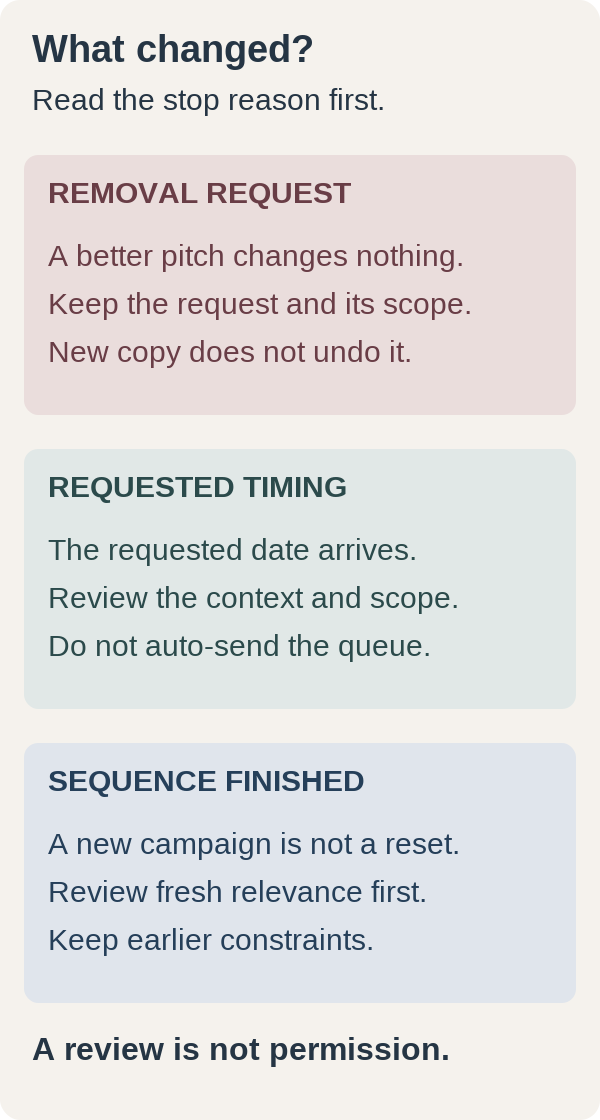
An editorial decision aid. A changed message, a resolved pause and a new campaign are different kinds of change; none automatically overrides a recipient constraint.
For a team using OKKI Go for company research, this distinction belongs between finding a relevant account and deciding to contact someone. More account detail can improve your understanding of fit. It does not settle a recipient’s wishes or replace checks in the system that sends the email. Keep the research benefit, and make the outreach decision separately. This essay does not claim OKKI Go automatically enforces the stop policy described here.
These are operating judgements, not a worldwide legal checklist. Applicable consent, unsubscribe and data-protection requirements need their own review; a B2B address is no general exemption. Useful personalization comes after those constraints and the reason for stopping have been checked. When someone proposes another message, ask what has changed for the recipient. If the answer is only what the agent can now write, the restart still lacks a reason.
Before asking the agent for a more personal message, ask it to show the reason the path stopped. What evidence would let you defend the decision to start again?
Frequently asked questions
Should AI outreach stop whenever someone replies?
Interrupt the automated pitch sequence when a real reply needs attention, then interpret it. A question can begin a human conversation; a removal request should end outreach within its stated scope. Ambiguous replies warrant a pause for review. Software reply-detection behavior varies, so check the actual workflow.
Can a new personalized message override an outreach opt-out?
No. Improved relevance or a different campaign does not itself cancel the recipient’s request. Preserve the request and its scope across records and campaigns. Any later contact must have an independently appropriate basis and satisfy applicable requirements, rather than rely on a better draft.
When can you restart an unanswered follow-up sequence?
Treat the completed attempt as finished. Reconsider later only with a fresh relevance review, earlier constraints intact and a bounded new plan where contact remains appropriate and lawful. New wording alone is insufficient. A scheduled review or new account event may prompt reconsideration, not automatic permission to send.