A first list can arrive in minutes. The better measure is what it takes to turn the list into work a rep can use.

Table of contents
A finished list can still be unfinished work
Suppose you're the rep opening a list the agent finished before the morning meeting. You flag a promising distributor, then find it only sells a competing category. The next company appears twice under slightly different names. A third fits, but your contact works for a different business unit. You haven't got a list you can use yet. The agent's run has ended; your research is just getting started.
The FinOps Foundation’s Unit Economics framework distinguishes resource measures, such as cost per token, from business measures, such as cost per case resolved. Both can be useful. A token measure tells you something about the system; a resolved case tells you what the organization got for its spending. Adapt that distinction to prospecting: the first list is an intermediate output. The business unit in this comparison is a usable account.
Think of a packaging supplier looking for distributors in an unfamiliar market. A usable account is a distinct company with enough checked evidence that it sells to the intended buyers, plus the information needed for the rep’s agreed next action. If that action requires contact, a plausible name without verified role and a usable contact route does not pass. An exploratory assignment that stops before contact can use a different rule, provided you use it for both workflows.
Count each eligible company once
Agree on the account boundary before you start. A rep can use several contacts at one firm and still have one usable account. Separate subsidiaries can count when the assignment treats them as distinct buying entities and the evidence supports that distinction. Missing authority or contact information can also justify an explicit hold. Do not change the definition after you see which run produced more names.
The work that moves off the tool bill
Start both clocks at the same point. How much of your team's time goes to briefing, screening weak matches, checking ambiguous records, finding missing contact routes, or correcting what made it into the CRM? Count it even when you reject the row. If the search runs while you're doing something else, that's elapsed time. If you have to sit and supervise, count how much of your attention it actually ties up.
Then record direct tool usage and paid data or contact lookups. If a subscription is shared, use the same allocation rule for both routes and say what is included. The FinOps Foundation’s Allocation guidance describes fixed and proportional shares as well as central budgeting for some shared costs. A useful distinction here: spare capacity on a plan can make the next run cheap in cash without making the whole subscription free to own.
For a cost comparison, add tool and data spending to staff time valued at your internal rates. Divide that total by the number of usable accounts. Keep the raw minutes alongside the cost, because a team deciding whether to buy more credits and a team trying to free up a reviewer’s afternoon are solving different problems. If retries consume credits, include them in tool spending. An account that takes several attempts to verify still counts once in the yield.
Checking company identity takes time
HubSpot’s deduplication documentation gives a concrete example of why the data path matters. It describes matching contacts by email address and companies by domain in specific workflows. An import without the listed domain or other unique identifier can create a new company for each row, and companies created through the API are not automatically deduplicated by domain. That is a documented CRM behavior, not a claim about your stack. Record the actual verification or merge work you needed.
A company can also be genuinely distinct but unsuitable, or suitable with an unusable contact. If the bad record leads to outreach, the team may spend time investigating a bounce, correcting the CRM, or explaining a mistaken message. Log those incidents consistently if you observe them, using the same follow-up window for both routes. Keep a serious sending error visible on its own; a low average cost should not cancel it out.
The faster run can lose on staff time
Consider two hypothetical runs for the same territory, buyer profile, and acceptance rule. They begin from the same CRM snapshot and have the same scope. The wide search gets its first list out in ten minutes. By the end of screening and correction, the team has spent 120 active staff minutes for 12 usable accounts. The narrow search needs 25 minutes to produce its first list, then reaches 16 usable accounts with 96 active staff minutes in all. These are invented inputs for the comparison, not measured agent results.
Divide 120 by 12 and you get ten staff minutes per usable account. Divide 96 by 16 and you get six. That's a win for the narrow run on staff capacity. Did it cost less in cash? You can't tell from these figures, and you still don't know which route gave your rep the first usable account sooner.
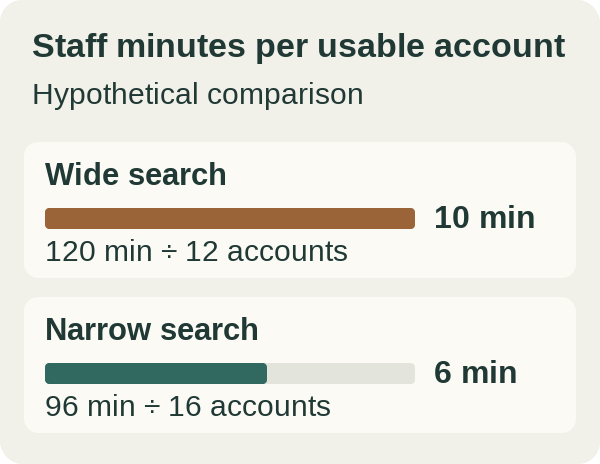
Hypothetical workflow comparison. Both bars use the same scale. First-list wait and tool charges are not included in active staff minutes.
Suppose both routes use staff at the same internal cost rate and yield similarly useful accounts. The narrow run can absorb a tool-cost premium per usable account up to the internal value of four staff minutes before its illustrated total crosses the wide run’s. If the teams use different skills or rates, value the actual time by role. The four-minute difference follows from these assumptions; it is not a benchmark for prospecting.
When the wider search is worth paying for
What if you're still figuring out how the market buys? You might want to see whether distributors, specialist installers, or contract manufacturers are worth a closer look. An excluded firm can show you where your channel definition was too loose; repeated results can point to gaps worth investigating. Write those observations down. If you're paying to learn about the market, give that work credit without counting every useful clue as an account that's ready for a rep.
Once your target is stable, it is easier to avoid paying for premature enrichment. For example, you can give OKKI Go a target market, buyer type, and exclusions, then review the company candidates against that brief. Choose which companies to unlock and carry forward only the accounts you verified fit the assignment. The point is to decide what deserves more work before doing it, not to assume the product removes review or lowers anyone’s costs.
Speed can also have a real payoff. If a rep needs the first few verified accounts before a trade show ends, time to the first usable account may matter more than the average by week’s end. Set the deadline and minimum evidence standard in advance. A quicker list is helpful only if it gets the rep usable work while the deadline still matters.
What would make you switch workflows?
Compare the two on the same buyer brief, with a common acceptance rule, review budget, and cutoff. Use the same starting account pool or comparable batches, and keep one route’s fixes from becoming free input for the other. If you cannot make the runs comparable, report the differences instead of treating the gap as a measured tool effect. For a recurring program, repeat the comparison with ordinary workloads so a lucky batch does not set the plan.
Keep staff minutes per usable account visible even if you also convert time to an internal cost. Time released is capacity, not necessarily payroll savings. Separate one-time setup from recurring handling, put a consistent share of recurring tools against the run, and report unusable accounts alongside the yield. If the cheaper route also gives you worse coverage of priority buyers, check what is missing before calling that a win.
Check your review queue before you trust the average. Imagine that most records clear a quick screen, but every account on your priority list needs a regional specialist who's already busy. You can spend little staff time in total and still miss your deadline. Measure the wait as well as the work. If that queue sets the pace, see whether your agent can hand over the original evidence with each exception. You don't need another batch if it only puts the next decision further back.
Before buying a faster model or raising an enrichment limit, look at the largest avoidable work item. If people keep reconciling the same company, fix the reuse or identity problem. If they mostly reject the wrong buyer type, tighten the search. If validation is already cheap and the first-list wait is the real constraint, spend on speed. The useful investment depends on where the work is actually piling up.
Before you ask how quickly the next list can appear, ask how much work will still be waiting when it does.
Frequently asked questions
How do you calculate AI prospecting cost per usable account?
Add attributable tool and data spending to the internal cost of all staff time spent up to the agreed milestone. Divide by the number of unique accounts that meet the same acceptance rule. If none pass, report the spend and zero usable accounts; the per-account figure is undefined, not zero.
Is a usable prospecting account the same as a qualified lead?
No. Here it is a unique company that fits the assignment and has enough checked information for the rep to take the specified next step. The definition does not imply buyer interest, permission to contact, a qualified opportunity, or a meeting.
Should you include rejected accounts in the calculation?
Include the time and tool usage spent screening or fixing rejects in the numerator. Leave rejected and duplicate companies out of the usable count. Keep useful exclusions in a separate record so you can reuse them without inflating that count.