The most useful result may be a better way to decide who belongs in your next search.

Table of contents
What did the run leave you?
Imagine an exporter of replacement filter cartridges entering a new territory. The team searches for industrial distributors, and the campaign ends with several requests for a catalog. At the review, somebody proposes expanding the list. Then a rep brings up an awkward detail: a distributor that requested the catalog said its equipment partner controls which replacement parts it can buy. A service contractor, meanwhile, could describe who reviews alternatives and how a sample would be assessed. In this fictional example, the catalog request and the description of the approval route answer different questions.
If you count the catalog requests, you know something about how the campaign was received. If you know who can put a replacement part forward for review, you can change how you search. Which answer did you actually need? For this exporter, the question is whether the company you contact can sponsor an evaluation under the current offer. A distributor with its own review route still fits. A service company that just places orders against an approved list may have the same constraint as the first distributor.
Write down what could prove you wrong
The NIST/SEMATECH handbook on experimental design starts with an objective and describes deliberately varying factors to observe a response. Use that planning discipline even for a small sales run. If you want to learn whether a buyer can sponsor an evaluation, write down what would count before you see the replies. Ask for a description of the last comparable review, including who brought the part forward and who decided. If you only ask people whether they want a catalog, you'll mostly learn what they say to that offer.
You can record this in one sentence: we expect this kind of buyer to be able to put a compatible part forward for technical review, and we'll look for a recent example or an identified route. That's a working hypothesis about access to evaluation. It doesn't test whether the filter works in a particular machine, whether the buyer has budget, or whether the opportunity will close.
A reply can expose the wrong problem
When you read the results, keep three things apart. An invalid contact leaves you with a reach problem. A buyer who understood the offer and says the trial quantity is too large gives you something to test about the offer. A buyer who says the manufacturer controls the parts list gives you a clue about the route to approval. Those observations could all appear under the same 'did not advance' label. If you change the target in response to all three, you won't know what the next list is meant to fix.
Think about what stays fixed when you compare batches. If you change the buyer type and switch from a catalog offer to a sample evaluation at the same time, a better response can't tell you which change helped. Where practical, keep the offer, outreach conditions, and review window comparable while you examine the buying route. If you can't, write down the differences. You can use the conversations to plan a better test without treating the response gap as its result.
A silent account still has an unknown answer
Did you reach the right person? Did the message make the offer clear? Was anyone reviewing parts at the time? Silence leaves those questions open. Conversely, a courteous reply or a forwarded catalog needn't mean the account can sponsor an evaluation. A useful review keeps the exact observation, identifies the rival explanation you still believe could matter, and says where to look next. It gives the person reading the results later something better than the label 'bad fit'.
Change the exact instruction you search with
Return to the filter exporter. The old instruction was to find industrial distributors that sell replacement cartridges in the territory. The revised instruction is to look for distributors or service firms that may be able to put a compatible part forward for review. You might prioritize company pages describing independent sourcing or cross-brand maintenance and mark them as clues. You still need a conversation or other credible account-level evidence to confirm who can sponsor the review. A website category is a way to find a candidate, not an answer about its authority.
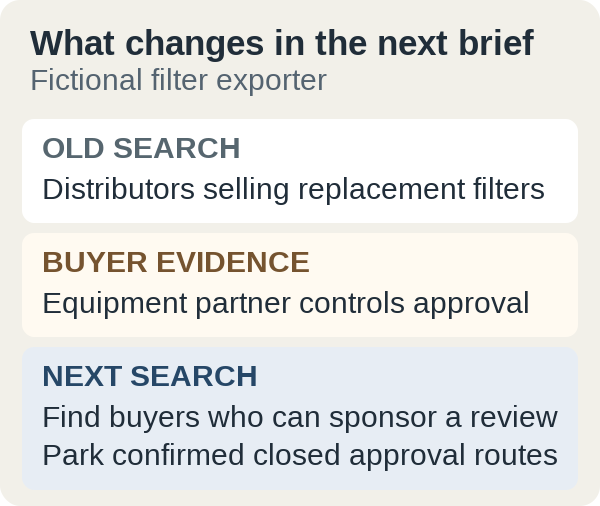
The same fictional export run produces a new search condition. A closed route is parked until new evidence addresses the reason.
Now add the exclusion and its reversal. For this offer, park accounts confirmed to take orders only against a manufacturer-controlled list when you have no route to the list owner. Leave the ones with unknown authority in a research group. Reopen an excluded account if you identify the approval owner and learn that a route to review the part is open. Write down where the observation came from. The next rep should be able to tell the difference between 'confirmed closed route' and 'nobody has checked yet'.
End with a decision someone can challenge
The UK Government Service Manual recommends open, neutral questions and asking for stories and real examples in research interviews. In a sales conversation, 'Walk me through the last time you added a replacement part' gives you more to investigate than 'Would you be open to an alternative?' Ask who raised the need, what could block the review, and whether the same route would apply here. A good story can reveal a mechanism; it doesn't tell you how common that mechanism is in the territory.
What if the live opportunity is good enough to pursue now? Pursue it. There's no reason to slow a serious buyer down while you review the rest of the batch. Just preserve what made that particular conversation different. If you keep hearing about an accessible review route from unrelated accounts, decide whether to promote it from a clue to a priority. If the only example was a partner referral with unusual access, keep the assumption open and look outside that referral path before extending it to other accounts.
A revised brief is useful only if it changes someone's next choice. The team using OKKI Go can carry forward the same territory and product, describe the candidate buyer roles and exclusions, and review the company results before deciding what to unlock. Keep an unknown approval route as a research question. The search tool can surface candidates; it can't turn a public company description into confirmation about who can authorize a review.
At the next review, put the old line and the new line side by side. Ask what observation earned the change, what stayed fixed, and which finding would make you undo it. If the strongest evidence is still an invitation to send a catalog, keep the earlier target and plan a better buying-process question. If you can point to a concrete constraint and an alternative route, send the next rep a narrower assignment. Give them the evidence as well as the new instruction.
Before you order another list, read the brief you would give a new rep. If it still asks them to make the same guess, the last run has one more thing to teach you.
Frequently asked questions
What should a B2B sales experiment leave behind?
A revised prospecting brief should say which accounts to seek, what evidence makes them worth pursuing, which accounts to set aside, and what would reverse that choice. Keep the buyer observation and its limits alongside the rule so another rep can use or challenge it.
Can a low reply rate invalidate your target segment?
Not by itself. A low reply rate describes the campaign as run. Before changing the segment, check contact reach, buyer role, the message, and the offer. A concrete buying-process detail can justify a narrower follow-up test without proving that the whole segment lacks demand.
When should you reopen an excluded account?
If you set a distributor aside for the current offer because it buys only from a manufacturer-controlled parts list and you could not reach the person responsible for approval, reopen it once you identify that person and verify a viable route to review the part. If the approval route is still unknown, keep the account in the research group.