AI prospecting teams should treat each handoff as an acceptance contract rather than a notification. A search result is not ready for outreach until the reason for selection, evidence, uncertainty, owner and next decision survive the transition. When a field can change the customer-facing action, stop or reroute it to a named human instead of strengthening the guess.

Table of contents
A search result is not ready just because it is relevant
What happens when an AI system finds a company that appears to fit, identifies a plausible contact and moves the record into an outreach queue? Yet the next person may not know which source made the account relevant, which parts are observed or what still needs checking. Consider a hypothetical industrial supplier entering a new market. A research workflow finds a manufacturer that matches the target industry and a commercial contact whose role appears relevant. This is not a customer case, a real campaign or a claim about the contact. The first question is simple: can the next person accept the record without rebuilding it? The harder question is “Can a human reconstruct why this account is ready for the next action?” Apollo’s guidance on the human-to-AI handoff describes governance as the boundary between autonomous work and work that requires human review. That boundary matters even when the next action is only drafting, because a draft can carry an unsupported claim into a real conversation. NextLevel.ai makes a similar distinction: rules, AI assistance and human ownership occupy different parts of the process, and a qualified handoff is different from a valid record. A notification says “something happened”; an acceptance contract says “this record is ready for this person to make this decision.”
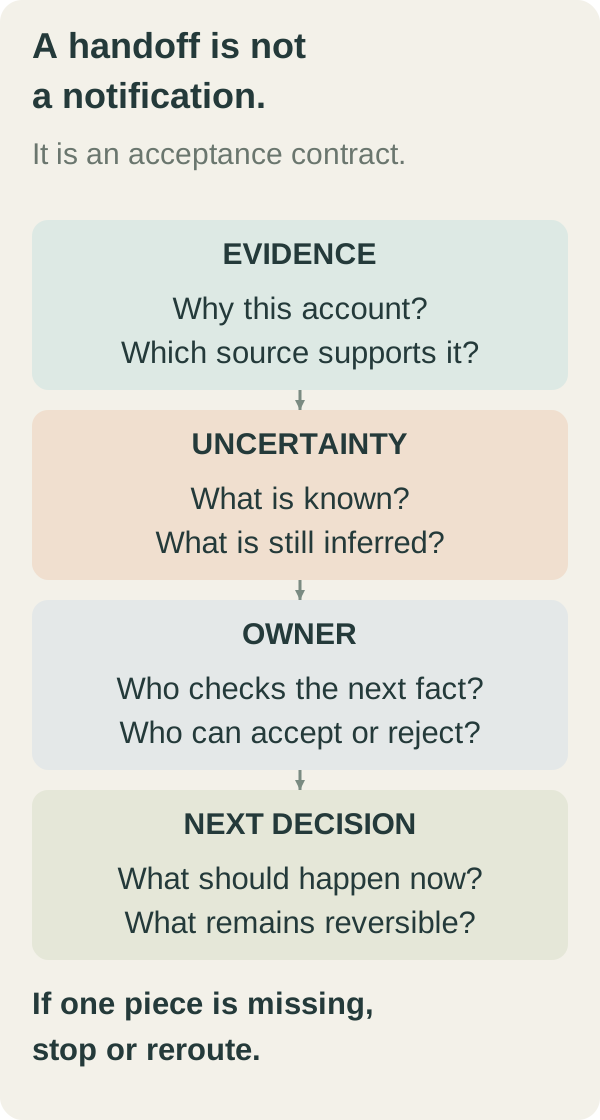
A handoff should carry evidence, uncertainty, ownership and the next decision forward.
What does the receiver inherit?
A reason, a source, a confidence boundary and a next decision. If the record carries only a score or a suggested message, you have not handed over a decision; you have handed over a new research task hidden inside a notification. The receiver still has to ask what the account means.
Test the four fields before you send
What should survive the first transition? Start with four fields: evidence, uncertainty, owner and next decision. Apollo’s handoff guidance separates autonomous work from human review, while NextLevel.ai’s workflow distinguishes a valid record from a qualified handoff. Together, those ideas give you a practical inheritance: why the account entered the queue, where the claim came from, what the record does not establish, who can verify the missing fact and what decision is being made now. Remove the generated message and ask another person to read only the account record. Can they explain why this company was selected, which contact hypothesis is being tested and what would make the team stop? Can you say why this account is next, without opening a second research task? Now change one field at a time. If the source is clear but the owner is missing, route the record to a named reviewer. If the owner is clear but the evidence is stale or indirect, keep the record in research. Apollo’s governance framing makes the boundary useful: the workflow should not grant execution authority merely because a previous step completed. NextLevel.ai’s qualified-handoff framing makes the test concrete. A handoff can be brief without being vague, but it must tell you what you are allowed to decide now.
The smallest useful handoff test
Complete this sentence: “I am contacting this account now because ___, based on ___, and I need to learn ___.” If you need to guess, stop. The missing answer is the handoff defect, not a prompt-writing problem. The answer should be visible to the next reviewer before any external message is prepared.
Rank the failure before adding more automation
Which failure is most likely? The account may be relevant while the contact role is inferred from a title. The source may be real but too old or broad for the claim in the message. The record may contain a useful fact but no owner for checking an exception. Or the handoff may be technically complete while the next action is still irreversible. Apollo, NextLevel.ai and Brandwell all point to governance, record quality and review as places to test them. What should trigger approval? A consequence, not a label. Human approval belongs where uncertainty changes the external action. A system may collect companies, normalize fields and suggest a contact. You should decide when a disputed role, sensitive inference, stale source or unusual request becomes a customer-facing claim. Brandwell’s discussion of agentic prospecting puts source evidence, identity checks, scoped tools, human approvals and verified actions in the same operating chain. Do not solve a source problem with more copy, an ownership problem with a higher score or an ambiguous reply by letting the workflow continue. Ask who can resolve the missing field.
Approval should follow consequence
Research can tolerate an open question. A personalized claim, stage change or cross-channel follow-up needs visible evidence and a named human owner. You should approve the action only when its consequence and responsibility are clear. The approval boundary should be visible before the record can change state or channel.
Verify the handoff, not the demo
How do you verify each transition? Replay one record from the original company search to the proposed first action. At the search step, check the inclusion reason and source date. At contact discovery, separate a visible responsibility from a title-based guess. At message preparation, underline every statement that depends on the account record. NextLevel.ai’s workflow gives this sequence a useful shape: validate the record, capture the trigger, prepare the first contact and route the response. If a reviewer changes the company rationale, preserve that correction instead of replacing the original without trace. If the reviewer cannot verify the contact’s responsibility, make the next action a routing question. What changed? Preserve the correction. If the message contains a claim no source supports, remove the claim or return to research. Apollo’s handoff guidance makes the reviewer’s boundary explicit: human review is part of the workflow, not a cosmetic sign-off after the action is already decided. Stop or reroute when evidence conflicts, the person cannot be identified with enough confidence, a reply changes the account context or a required owner is unavailable. Brandwell’s approval-and-verification framing supports treating those cases as exceptions rather than allowing the workflow to continue.
The exception is part of the workflow
An exception needs an owner, a visible reason for the stop and a defined restart condition. Without those three fields, the system either stalls silently or keeps acting on a record whose meaning has changed. The exception route is part of the workflow.
Replace the notification with an acceptance contract
What corrective action would you accept as usable? Build the receiving contract around the decision: preserve the selection reason, source freshness, uncertainty, contact responsibility, claims and reviewer. Practitioner discussions emphasize confidence, reasoning behind data, source quality and the next action; a CRM status alone does not prove a conversation. Another community discussion recommends carrying source passages behind extracted commitments and using controlled labels before stage changes or follow-ups. These are practices, not benchmarks. In the hypothetical supplier, the accepted handoff might read: “This manufacturer matches the target sector because of these public operating signals. The contact appears responsible for commercial partnerships, but that responsibility is not confirmed. The first message should test who owns the process, not claim an active project. Alex owns the role check; if the source cannot be confirmed, stop outreach.”
Would you send this record if you had to explain the source in one sentence?
OKKI Go can help with company research, but the handoff contract still belongs to the team. A contact result is not proof that the person owns the decision.
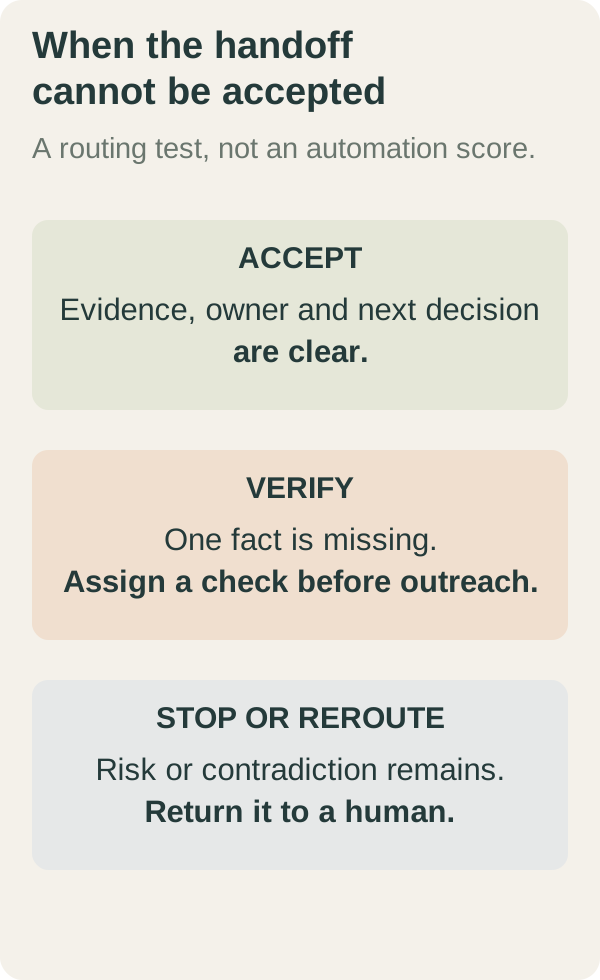
A missing field should route the record to a question or a stop, not to a stronger guess.
Know when the record is not ready
When should you escalate? When an unverified fact can change the message, sources conflict, a reply changes context, scope is exceeded or no one owns the next decision. Apollo and Brandwell treat ownership as a control. Uncertainty is normal; unowned uncertainty that can change a customer-facing action is the threshold. Keep the account in research or return it to the person who can verify it. NextLevel.ai separates record validity, handoff quality and exception review. Ask: What do we know? What do we infer? Who owns the missing check? What action is allowed now? What would make us stop?
Where do you see information lose its meaning? Usually when a useful observation becomes an unowned action. Treat the handoff as an acceptance contract rather than a notification.
A final acceptance test
Do not ask whether the workflow produced a record. Ask whether the next person can accept it without reconstructing its meaning. That is the difference between moving data and moving a decision, and it is the handoff quality distinction described by NextLevel.ai.
The search is only the beginning. Carry evidence forward, name the uncertainty, assign the next check and keep the action reversible until a person accepts it.
Frequently asked questions
What should an AI prospecting handoff include?
It should include why the account was selected, the source behind that reason, what is known, what is still inferred, who owns the next check and what decision the receiver is being asked to make. A score or generated message is not a complete handoff.
Where should human review happen in an AI prospecting workflow?
Human review belongs where uncertainty can change a customer-facing or consequential action, such as a personalized claim, contact responsibility, CRM stage change, reply route or cross-channel follow-up. Routine research can be automated more freely when its evidence and limits remain visible.
How should a team handle an uncertain prospecting record?
Hold or reroute the record to a named owner. Preserve the reason for the stop, the missing or conflicting evidence and the condition for restarting. Do not keep the workflow moving simply because an AI-generated message already exists.