The small word “if” can matter more than everything else the meeting summary captured.

Table of contents
Before you send the recap
You are about to send a follow-up after an exploratory call. Your draft says the buyer is interested, the technical discussion was positive and a trial is the next step. It reads cleanly. Before you approve it, read the sentence that is supposed to justify that trial. In this fictional example, a materials supplier hears: “Send the cleaning details. If engineering is comfortable, we can discuss a trial.” The supplier, customer and wording are invented; no model has been tested on this conversation. You have a request for information and a conditional possibility. You don't yet have an agreed trial.
Your choice is immediate. You can send a quotation as though evaluation is arranged, or send the requested information and ask what the engineer needs to assess. The same call supports very different actions depending on whether the recap preserves the condition. Counting how much the AI captured will not settle that choice. What matters is whether the words it kept justify the move you are about to make. A long recap can contain the right topic while losing the qualification that gives the topic its meaning.
A transcript keeps words; a summary selects meaning
A transcript gives you a record to examine; a sales summary selects what deserves attention. Microsoft’s Dynamics 365 call-summary documentation, checked on November 18, 2026, describes suggested notes for action items, commitments and next steps, with timestamps leading back to transcript and playback. That gives you a place to check a proposed action. It doesn't establish that every generated note is accurate or that a suggested next step was agreed by the buyer.
Two recaps, two different decisions
Read a deliberately lossy recap of the fictional call: “Buyer is ready for a trial. Prepare the quotation.” It has an action and sounds useful, but the buyer didn't say either thing. “Can discuss” has become “ready”; engineering’s prerequisite has vanished. The error is not a missing meeting detail. It is an added commitment. If you approve this version, your next email starts from a commercial position the conversation has not established. A polished sentence can be more misleading than an untidy note when it makes that addition difficult to notice.
Now read a decision-oriented version: “Buyer requests cleaning information before engineering considers a trial discussion. Send the information and ask which conditions need checking; trial agreement and purchase timing remain unconfirmed.” This doesn't predict whether the material is suitable or whether the buyer will buy. It identifies what you can do now and what you still need to learn. The proposed question is the seller’s recommendation, not another promise attributed to the customer. Your next email can answer the actual request without inventing a date, budget or evaluation slot.
The useful difference is permission to conclude. You can shorten greetings, repetitions and the order in which topics arose. You can't replace a prerequisite with an outcome. If the engineer later approves a discussion, record that as new evidence rather than quietly rewriting the original call. Equally, don't keep an old uncertainty once the buyer has actually resolved it. The summary should reflect the latest confirmed position, including a clear agreement when one exists.
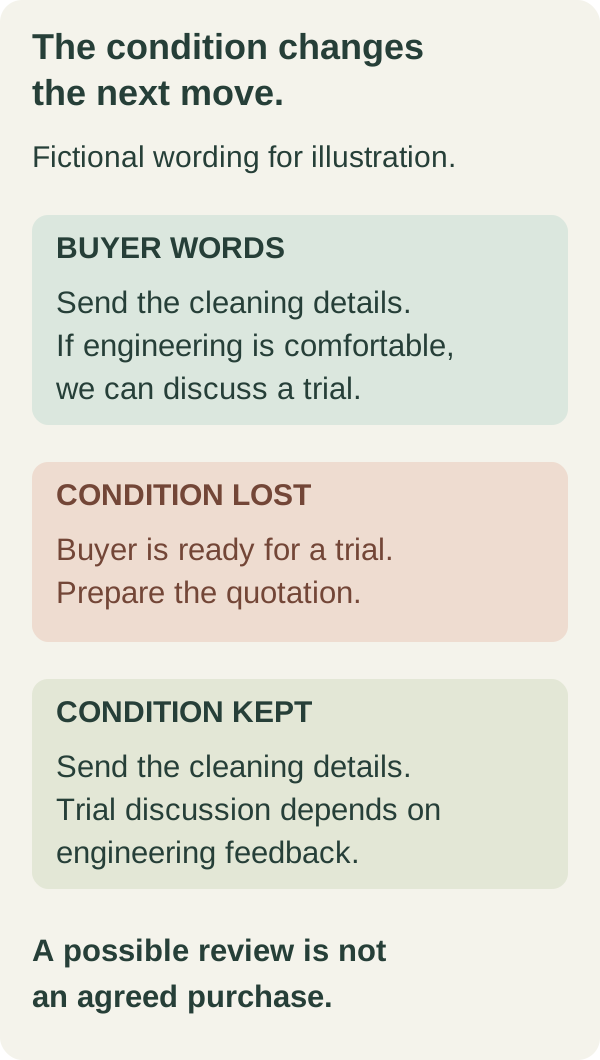
Invented wording illustrates a change in meaning, not a recorded customer call or a measured AI error.
Keep a request separate from a commitment
HubSpot’s call-review documentation, checked on November 18, 2026, separates decisions made, sentiment and next steps into different summary sections. That product design doesn't prove how a buyer thinks, but it is a helpful distinction when you inspect your draft: a friendly tone, a topic discussed and an agreed action answer different questions. In the fictional call, the request for information is clear; willingness to hold a trial remains conditional.
The words that change the follow-up
Look for the language that limits the next move: if, after, subject to, need to check, can't yet confirm. You are not hunting for a vocabulary blacklist. You are asking what would be different if that condition were false. In the imagined materials discussion, an engineer who is not comfortable changes whether a trial can even be discussed. Removing that condition is therefore different from removing a repeated explanation. It changes the decision. A recap that retains the subject of the conversation but drops this dependency has preserved the topic and lost the commercial meaning.
Return to the source passage before accepting the stronger interpretation. Microsoft’s documented timestamp route is useful here because it brings you back to the surrounding transcript and playback, not just the extracted phrase. Check who spoke, what the statement refers to and whether an earlier sentence supplies a condition. The source record can also be incomplete or misheard, so reopening it is a verification step, not a guarantee. If you still can't establish the meaning, ask the buyer for clarification instead of asking the summary to sound more confident.
Keep your own recommendation visible as a recommendation. “Ask engineering which cleaning conditions matter” is a proposed seller action; “engineering agreed to test” is a claim about the buyer. You may have a sound reason to propose the first while having no evidence for the second. The same applies to dates. A seller wanting to follow up on Tuesday doesn't establish that the buyer promised an answer on Tuesday. Your summary needs enough separation to let you plan work without manufacturing a customer obligation.
This is also why “unknown” can be a useful result. If budget or purchase timing didn't come up, don't let an empty field become “no budget” or “not buying this quarter.” Silence supplies neither conclusion. Record that you don't know, then decide whether the missing answer matters to the current move. You don't need to interrogate the buyer about everything before sending a requested document. You do need to avoid turning missing information into a reason to advance or abandon the opportunity.
When more notes are worth keeping
There is a fair objection: a short decision note can discard detail that another reader needs. A technical specialist may need the operating conditions, a colleague returning after a long gap may need the sequence of the discussion, and a team may have legitimate recordkeeping requirements. Keep the fuller record where it is appropriately available. The point is not to delete it or impose a universal word limit. Put the present decision in the brief, and make the underlying context available when it changes the interpretation. Concision is useful only while it preserves meaning.
Don't make every summary cautious by default. If a buyer explicitly agrees to a defined next step, keep the agreement and its scope. A clear request for a quotation deserves a different response from a tentative trial discussion. Still, a request for a quotation is not an order. Read the agreement at the level it actually establishes. Your summary can show progress without promising a later decision that nobody has made. This keeps the method useful for straightforward conversations as well as uncertain ones.
Account background has a different job. Whether you found the company through OKKI Go, a referral or a trade show, research can prepare a relevant question; it can't tell you what this buyer agreed during a conversation. Keep observed words separate from expectations you brought into the call. In the fictional materials example, the next email should provide the requested cleaning details and clarify the engineering question. You can reconsider a trial when you have the answer. Until then, a longer set of notes doesn't create stronger permission to proceed.
Before you approve the follow-up, read it beside the buyer’s actual words. If the proposed action needs an agreement that is not there, change the action or ask the question. More notes cannot supply that missing agreement.
Frequently asked questions
What makes an AI sales call summary useful for the next decision?
It makes clear what the buyer requested or agreed to, which conditions remain unresolved and what the seller proposes doing next. Enough source context should remain available to check those distinctions. The number of captured details is less useful than whether the recap supports the action you intend to take.
Should every suggested next step in a sales summary become a CRM task?
Treat the suggestion as something to review. A seller can plan a clarification task without claiming the buyer has committed to a trial or purchase. Verify who made the statement, what it referred to and which prerequisites still apply before updating the commercial interpretation of the conversation.
Should you replace detailed call notes with a short AI summary?
Keep fuller context when it is needed for technical review, continuity or legitimate recordkeeping. A short summary is a decision aid, not a substitute for every underlying record. It should point you toward the issue that changes the next move without hiding conditions or creating missing facts.