Choose customer evidence for the buyer’s unresolved question. A reference may support delivery experience, a reported outcome or work under particular conditions; it does not promise the same performance for another application. Explain what is comparable, keep the result attached to its context and name what remains unverified. A recognisable logo is not a substitute for that explanation.

Table of contents
What does this reference answer?
“Have you worked with a business like ours?” It sounds like a request for a name. It may be a question about whether a supplier can deliver reliably, whether a product fits an application or whether a proposed improvement is worth the cost. Before you select the most impressive customer story, establish which uncertainty the buyer wants it to address.
Consider a hypothetical supplier of industrial marking equipment. It has permission to discuss a previous project involving flat cartons on an automated conveyor. A new prospect wants to mark glossy curved containers handled differently. The seller has a relevant-looking industry story, but the application is not identical. This is an invented comparison, not a real customer record or a claim that any equipment has been tested on those materials.
What can that story reasonably establish? A documented delivery history might help answer whether the supplier has completed comparable work. A result from the earlier application might explain what was achieved under those conditions. Neither automatically answers how the proposed setup will behave on a different surface with different handling. The useful part of the reference depends on the question.
A service reference is not an application test
A customer might be able to describe the supplier’s responsiveness and delivery follow-through without having evidence about a new application. Those observations can still matter. The error would be to present praise about one aspect of performance as though it established another.
One formal illustration is the U.S. federal past-performance framework: FAR 42.1503 lists technical quality, schedule and business relations separately. Checked on November 16, 2026, it offers a useful distinction between questions. It isn't this private overseas buyer’s procurement procedure, and the buyer doesn't need to adopt a government scorecard to ask whether a reference actually addresses the concern.
Similar in which way?
A familiar industry label is a starting point, not the whole comparison. In the hypothetical marking discussion, the relevant differences could include the material and shape, the handling arrangement, how the mark is checked and the support available on site. These are questions to establish with the buyer, not a universal technical checklist or an assertion that each difference will affect the result.
You can have a reference in the same industry that leaves the decisive condition unexamined. You can also have work in another industry that bears directly on a delivery or support concern. Ask what needs to be similar for the particular comparison to be useful. “They are a large manufacturer too” may say much less than a clear account of the work the supplier actually undertook.
What about a strong result in the story? Keep any outcome you report attached to its basis. What changed, compared with what starting point, over which period, and with what other work happening at the same time? A case describing a wider project should not become a claim that one supplied component produced the entire result. If you don't have those details, the number needs qualification or should stay out of the promise.
A buyer may only need enough evidence to decide whether the application deserves investigation. A reference can be useful at that stage without proving final suitability. What it can't do is remove a remaining uncertainty simply because the customer name is recognisable. State the part that is comparable and the part that is still open.
A logo does not describe the work
A logo may identify a claimed relationship, but it doesn't show what was delivered, when it was delivered or which part of the customer’s business used it. Even a genuine relationship can involve a different product, location or scope. Where you have permission to discuss the relationship, a brief description of the actual work is more informative than expecting the name to carry every inference.
Whose account can the buyer examine?
Which source would answer the question best? A supplier-written story can give a coherent account of a project, but it's still a selected account. A direct reference can let a buyer ask about the relevant work, but the speaker may only know part of it. Access to a customer doesn't turn every answer into a technical verification.
Wiik and colleagues’ 2025 qualitative study in the health technology sector examines similarity, authority and objectivity as mechanisms that legitimate customer referencing within a community of practice. Its findings and limitations were checked against the published paper on November 16, 2026. For this discussion, it prompts questions about the speaker’s relevant experience and the presentation of the account. It doesn't validate the hypothetical marking application, establish a universal buyer rule or demonstrate a conversion effect.
The practical distinction is between a person with knowledge of the relevant work and a person who can offer only general praise. A delivery contact may be well placed to describe communication and schedule. A technical user may know what was checked in the application. The buyer’s question determines which account would be useful, rather than the seller choosing the most enthusiastic speaker.
Customer time and confidentiality also belong in the decision. Use only material you're permitted to share, agree the scope of any conversation and avoid handing over operational detail or contact information merely because a prospect asks. If a name can't be shared, describe what can be supported and what can't be independently checked. Do not invent a customer, inflate an anonymous story or imply permission that has not been given.
And if there is no close reference? Say so. A supplier may be new to this combination of conditions while having relevant experience elsewhere. Existing evidence can be explained honestly, and a buyer may consider a scoped demonstration or verification appropriate to the unresolved question. That is a different source of evidence, not a replacement history the seller gets to claim already exists.
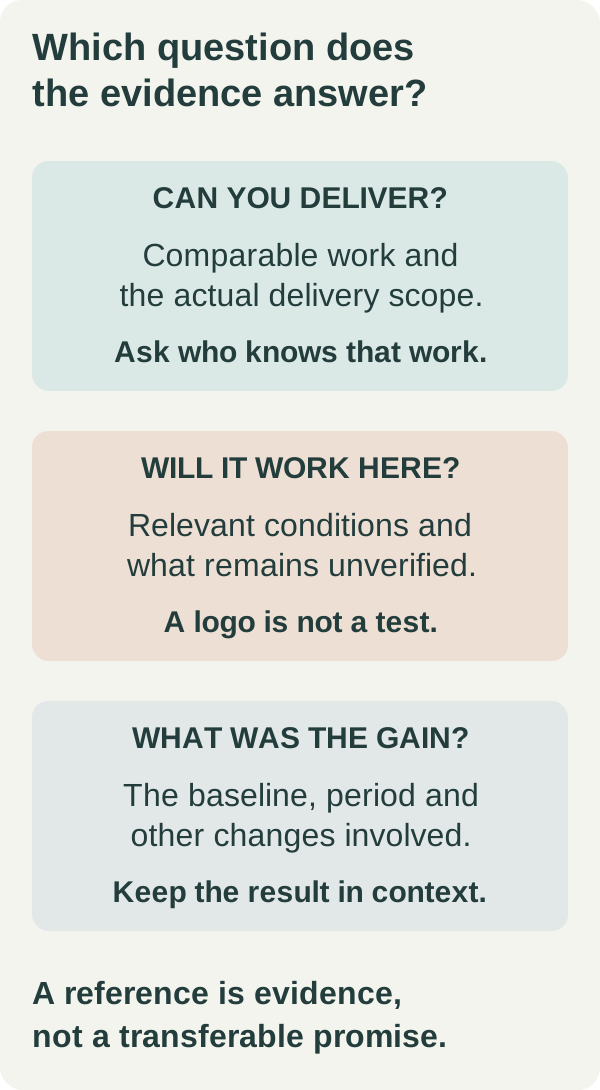
Questions for selecting evidence, not a ranking of suppliers or a prediction of results.
Send the reference with its limits
Return to the hypothetical marking supplier. The original sales move would be to send the carton project and let the prospect assume that a similar customer means a suitable solution. A more useful introduction makes the comparison explicit before the story is read. It doesn't need to make the past work sound smaller; it needs to stop the evidence doing work it can't support.
An illustrative introduction could say: “This project involved flat cartons on an automated conveyor. It is relevant to our experience of delivering that type of setup. Your curved containers and handling arrangement differ. The attached account doesn't establish marking performance in your conditions. We would need to agree which relevant samples and checks could address that application question.” These are hypothetical statements, not a summary of an actual completed installation.
The change is visible. The buyer can now distinguish an experience claim from a suitability claim and ask about the difference. No test, technical acceptance or sale has been demonstrated. If the actual concern is how support was handled, an agreed conversation with someone who knows that work may be more relevant than a new product presentation. If the concern is the new application itself, the reference leaves that question open.
FAR 15.305 provides another bounded analogy: in its U.S. federal context, past-performance information is considered with attention to currency, relevance, source and context. The point borrowed here is to examine those features, not to impose federal evaluation rules on private buyers. A past record needs interpretation before it can inform a different decision.
Whether the prospect was found through OKKI Go, an exhibition or a referral, company background doesn't make the old project a match. The current application and the buyer’s actual concern still need to be established. Choose a reference for the specific question, explain the limits of the comparison and accept when another kind of evidence is needed.
A good customer story deserves to be used accurately. The buyer should leave it knowing what the supplier has done, why that matters to this decision and what it has not yet established. That is a stronger use of proof than asking one impressive name to answer every question.
Frequently asked questions
How do you choose a relevant customer reference for a B2B buyer?
Start with the uncertainty the buyer wants to examine. Then identify past work, conditions and a source able to speak to that question. Industry and company size can provide context, but they do not replace the details that make delivery experience or application evidence comparable.
Does a customer success story prove a product will work in another application?
Not by itself. A past outcome describes particular work and conditions. Different materials, handling, integration or operating arrangements may leave questions unresolved. Explain the relevant similarities and differences, and use appropriate further evidence where needed instead of promising that the previous outcome will transfer.
What if a supplier cannot share a close customer reference?
State the gap without inventing a customer or disclosing information without permission. Explain which existing evidence can be shared and what it supports. The buyer may consider a suitable check or demonstration for the remaining question; that does not turn limited history into a claimed completed project.