The warehouse approved one roll of stretch film. Purchasing wants ten cases. A single draft order line can show what is still missing.

Table of contents
The Buyer Approved a Roll. Purchasing Orders Cases.
The sample was a single roll of stretch film. The buyer’s warehouse team tried it, liked the way it ran on the packing line, and approved it. Then purchasing asked for ten cases. In this hypothetical example, a case contains four rolls, the supplier’s quote is priced by the roll, and the buyer’s catalog has only a roll record. If you're entering the order, you can find the film. You can't select the case you were asked to buy.
From the supplier’s side, the silence might look like a buyer reconsidering the product. Before you ask whether the trial went well, ask what purchasing sees when it tries to enter the line. A missing ordering unit calls for a different conversation from a buyer who still hasn't agreed to a minimum purchase. Sending both people the same product brochure won't tell you which conversation to have.
Which Item Does ‘One’ Mean?
One roll is the item the warehouse used. One case is what purchasing wants the supplier to ship. What happens if you enter ten against the roll? You'll get ten rolls, not the forty the buyer expects. Write out the pack relationship in plain language: one sealed case contains four of the approved rolls. Then ask whether the buyer needs a separate case record or can buy at case level using its existing item record and a unit conversion.
There may also be more than one identifier in the conversation. GS1 US distinguishes a GTIN, which identifies a trade item across partners, from a SKU, which is an internal code. It describes GTIN-14 as used for groupings such as a case or set pack. A buyer’s roll SKU, a supplier’s item code and a case-level identifier can therefore point to different things. Give each identifier a label and state which package it refers to; a bare string of digits is easy to put in the wrong field.
Read the Order Line Before Correcting the Catalog
Say you're checking two lines for the same delivery. Call the agreed roll price P. One line says ‘40 rolls at P per roll’; the other says ‘10 cases at 4P per case.’ If one case holds four rolls and there is no separate case price, the product subtotal is 40P either way. If the buyer copies the roll price into the case price field, the line extends to 10P: one quarter of the expected subtotal. The shipment still contains forty rolls. Only the price basis has changed.
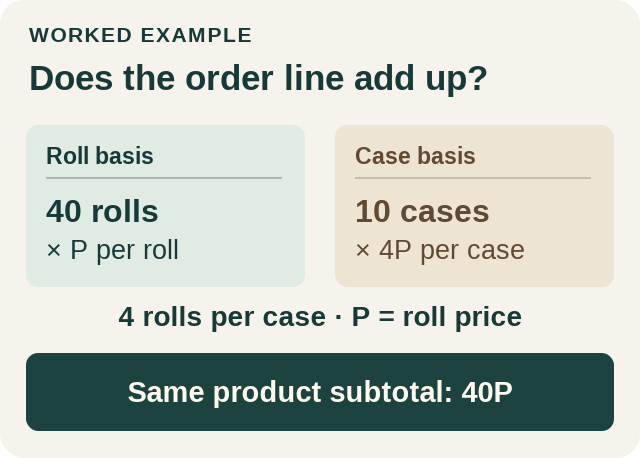
The same fictional order, checked on two price bases. Subtotals exclude other charges.
A Case Can Have Its Own Identifier
Start by checking which package the buyer’s identifier points to. You can have a perfectly good label on the carton and still see a roll-only record on the buyer's screen. Your case code can be useful even when the buyer uses a different one. Show the relationship in a format the buyer accepts: the approved roll’s identifier, the identifier for the four-roll case if required, and the count linking the two. If the supplier sells the same roll in two case sizes, name the one being quoted. ‘Case’ alone leaves the count open.
Walmart’s public supplier requirements show how item identification and case specifications can sit alongside each other. The retailer links GTIN and UPC identification to its item file. It also asks suppliers to check case durability, size, markings and labelling against its processes. That is a documented retail example of product and package requirements living side by side; it is not a checklist for every industrial buyer. The packaging distributor in this example may ask for less, or may need a different set of attributes to accept the case.
Price the Unit the Buyer Will Use
In the stretch-film example, a pricing unit of ‘roll’ and a purchase unit of ‘case’ can both be right if the buyer’s process supports the conversion and produces the expected total. Multiplying the roll price by four works here because the example assumes there is no separate case price, discount or charge. If you're checking a real order, ask whoever owns the quote to confirm the case price. Correct arithmetic can still reproduce the wrong deal.
Find the Team That Can Clear the Block
Ask the buyer to show you the closest it can get to a draft order, or to describe the field that stops it. If it cannot find the offered case, give the item setup owner the approved product reference, correct pack count and the relevant case data it asks for. If the buyer finds the item but gets a quantity or price you don't recognize, put your quote and their draft next to each other. The buyer’s purchasing or item-data owner can check the entered unit and conversion; the supplier’s sales operations team can confirm what the quote actually prices.
Oracle’s JD Edwards EnterpriseOne inventory guide offers a concrete example of how purchasing, pricing and shipping units can be stored separately. It describes unit conversions for items handled in more than one unit. That illustrates why an order can look valid on one side and come out differently on the other. The buyer does not have to use Oracle or keep separate records for each pack. The useful check is whether both sides can turn the same line into the same quantity of the same item, at the same agreed price basis.
A useful reply from item setup should name what is missing. “We need the dimensions of the sealed four-roll case” gives your packaging team a job. “The conversion says one case equals six” gives both catalog owners a value to check against the actual pack. If the reply is “we have no approved price for the case,” take the quote back to the commercial team rather than treating the price as a field somebody can fill in from memory.
When the Case Is Ready but the Order Is Not
Now suppose the buyer can build the ten-case line correctly, but the supplier’s export quote assumes a twenty-case minimum. The pack count is right and the catalog record is usable. No extra barcode will bridge the minimum. The commercial owners need to agree whether ten cases are acceptable, revise the quantity, or keep the purchase on hold. The same applies when the line is technically ready but payment terms or the requested delivery date are still open.
Are several otherwise ready items stuck with the same buyer? You'll want to check the supplier account as well. Ask whether the supplier account is active for the intended buying entity and whether an approval is outstanding. Let the buyer identify the blocker. A correct item record addresses the item; it doesn't tell you what the buyer has authorized.
Ask to See the First Line Before It Is Released
The next request can fit in an email: ‘Can we check one draft line for the first shipment? We expect ten cases of the approved film, four rolls per case. Could you confirm the order unit, identifier and price basis you'll use?’ A buyer may prefer to confirm the fields without sharing a document. That still works: send back what you understand the quantity and subtotal to be, and ask what, if anything, would stop release.
The check may be much shorter for a buyer that orders by roll. If it can enter forty rolls against the existing record and the supplier confirms that those rolls ship as ten sealed cases, there may be no reason to create a second item. Keep the packaging requirement visible so receiving knows what will turn up. If purchasing and receiving expect different case sizes, resolve that with the buyer even if the line totals correctly.
Keep the buyer’s approval, a reconciled draft line and a released purchase order separate in your notes. The first tells you the product passed a buyer check. The second tells you how the transaction is supposed to read. Wait for the actual purchase order before recording it as received. You'll know who to follow up with in the meantime, and you can ask them about the specific thing that still needs to happen.
Before you ask when the order will arrive, find out whether the buyer can enter the same line you would ship.
Frequently asked questions
Can a buyer approve a product but still be unable to order it?
Yes. The sample can be approved while the ordering record, unit conversion, supplier account or commercial approval is still incomplete. Ask the buyer where it gets stuck on a draft order before requesting another product review.
Does ordering by the case always require a separate SKU?
No. The buyer may need a separate case record, or it may use an existing item with a case ordering unit and conversion. Confirm how that buyer identifies the case and represents the roll count before sending new item data.
Can the supplier quote per roll when the buyer orders per case?
Yes, if both sides agree on the conversion and price basis. Check the number of rolls per case, the unit price on the purchase line and the extended subtotal. Confirm any case-specific charges or price breaks separately.