Two distributors can carry the same category and need very different first offers. Find out how each one gets the product to its customer before asking either to hold stock.

Table of contents
The Same Enclosure, Two Different Orders
Imagine you export die-cast electrical enclosures. Two overseas wholesalers list boxes that look a lot like yours. You have a sample ready and enough room in the next production run for an opening order. One buyer asks whether you can supply a particular installation. The other asks whether a contractor could pick up a replacement at the branch tomorrow. Treat those questions as interchangeable and you’ll give one of them a quote they have little use for.
What can you tell from the catalog? A stocked line is one the distributor normally plans to have available at a specified location. It can still sell out. A special-order item may appear alongside it without any standing stock commitment, and sometimes there’s a unit available anyway. Even a photograph of a full warehouse won’t tell you where your enclosure would sit, if it sits anywhere.
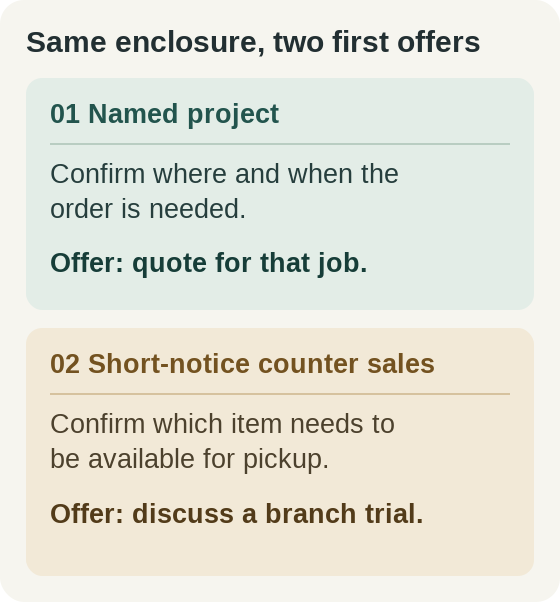
In this hypothetical example, the buyer’s delivery window changes the offer.
What a Catalog Label Can Tell You
WebstaurantStore makes this distinction explicit in its Special Order FAQ, checked in November 2026. It offers some items it does not normally hold in its warehouses. The manufacturer may ship one of those items directly to the customer, or WebstaurantStore may receive it with its next stock order and ship it from there. The same label can cover two different routes. The FAQ describes that seller’s practice; it says nothing about the commercial terms behind any particular item.
In its guidance on evaluating foreign representatives, the U.S. International Trade Administration recommends looking at the size, condition, and location of their offices and warehouses when a visit is possible. That can help you check whether local fulfillment is plausible. It still leaves the product-level question open. Ask how the distributor supplied the last comparable enclosure, and distinguish what it does for that product today from what it might do for yours.
What a Special Order Has to Deliver
Go back to the buyer with the installation coming up. When does the installer need the box? You already know when your factory could ship a carton, but that date alone won’t help the buyer plan the job. If you receive a list of quantities and variants, ask where the order must arrive and whether you can split the delivery. The answer changes which production slot and freight route you should quote.
Suppose the distributor can add your carton to a consolidation it already runs. That may suit a buyer with a flexible installation date. The carton then has to make the cutoff for the consolidation and still get from the wholesaler to the installer. If that schedule misses the job, direct shipment may work instead, but only if the distributor agrees on where the goods go and who handles receipt and any problems. A short factory lead time can coexist with a late delivery.
Quote to the Installation Date
For this distributor, offer to price the specified boxes for the named job. State the quantity or minimum, the delivery point, the assumptions behind the arrival estimate, and what the buyer must confirm before you reserve a production slot. If the only way to hit the date is expensive freight or a batch much larger than the buyer needs, show that constraint up front. A special order saves an opening stock commitment only if the individual order still makes commercial sense.
When Local Stock Earns Its Place
Now you’re talking to the wholesaler whose customer needs a box at the counter tomorrow. You have the same factory and freight options. None of them can reach the branch in time. Would the buyer have the same problem next week? If similar requests keep arriving with that little notice, local stock may solve a problem you can’t address from your factory. If it was one emergency and the distributor can source substitutes, you don’t have much of a case for stocking your line.
Newark’s pricing and availability guide, checked in November 2026, gives a useful counterexample to reading stock policy from a product page. Newark says an item it does not normally stock may still have inventory up to the displayed quantity. Additional quantities follow the displayed lead time. Seeing units available today can help you answer today’s order. It cannot tell you the company will replenish the item or where a different distributor keeps equivalent stock.
Ask for two details before discussing an opening order: the specific enclosure variant the branch needs and the pickup or delivery window it regularly has to meet. “We get calls for these” could mean repeated requests for one size, or scattered requests for sizes that cannot substitute for one another. Only the first answer makes a narrow trial of that size an obvious proposal. In the second case the distributor might stock a base variant and handle the less common sizes against named jobs.
That changes the shape of the offer. Instead of putting the whole range on the shelf, discuss one variant at the branch that actually serves those customers. Agree on who buys and holds the trial units and what will happen to any that do not move. Give the distributor the realistic replenishment time. If the quantity that makes the shipment economical is larger than either company is willing to carry, you may have a good product and no workable stock offer yet.
Make the First Offer Fit the Delivery Route
For the project-led buyer, the next move may be a request for the installation date, delivery address, and variants so you can quote for that order. For the branch serving contractors on short notice, ask which product it repeatedly needs ready for pickup, then talk about a limited local trial. Both buyers can sell the box. Only one has described a problem that a standing supply of boxes can fix.
What if the distributor just asks you to send a price list? You can send a line card without committing availability or treating the request as an opening order. Keep the account in research. One question will teach you more than another price sheet: “Where did you ship the last order for a box like this from?” Follow up on how long that customer could wait and whether the order was typical.
This is also a useful distinction when you build a list. Give OKKI Go the product, country, and buyer type to surface candidate companies. Review their public product pages and fulfillment terms before deciding who warrants a conversation. If the page only shows a category match, put the supply route down as unknown. You can take a targeted question into the call without recording an unverified channel capability as a fact.
Revisit the choice when the way customers order changes. Several scheduled jobs for the same variant could justify asking whether any customer now needs it sooner. Equally, a branch can decide to quote that variant only against projects if its early stock orders do not reveal a repeat short-notice need. For the first proposal, ask which customer order the distributor would struggle to fulfill without you. What it tells you about that order is more useful than how many similar products appear in its catalog.
For your next distributor call, pick one variant and ask how a customer would get it by their required date. Build the first offer around the route the buyer can actually use.
Frequently asked questions
Can a special-order product ever be in stock?
Yes. A seller can have some units available without stocking the product routinely. Newark’s availability guide describes that possibility for items it does not normally stock. Confirm the quantity, location and delivery date for the specific order.
Does a special order have to ship directly from the manufacturer?
No. It can ship direct, or the distributor can receive and forward it. WebstaurantStore’s Special Order FAQ describes both routes. Before quoting, confirm which one applies and who will receive the shipment.
When should an exporter propose a local stock trial?
Discuss it when the same variant is repeatedly needed faster than project-by-project supply can deliver and both sides can agree on a feasible trial quantity, stock owner and replenishment time. One urgent request alone leaves repeat demand unproven.