A request for a price can support a budget, a supplier comparison, or an order. The right quote is the one precise enough for the decision it must support.

Table of contents
A Price Request Can Hide Three Different Decisions
A buyer emails: “Please send your best price for 20 industrial pumps.” What do you send back? A complete quotation may feel like the safe answer. It may also be the wrong one if the buyer is still comparing solutions for a budget, or if the delivery point and pump specification are not settled.
The useful question comes before the price: what will the buyer use this quote for? You may be helping someone decide whether a project fits a budget. You may be helping a buyer compare suppliers on the same scope. Or you may be giving a buyer enough certainty to authorize the next transaction. Those are different jobs, so you need different evidence for each one.
The UK Government’s guidance on preliminary market engagement, checked on November 25, 2026, gives a public procurement example of this distinction. It says market engagement can clarify requirements, assess market capacity and develop a procurement strategy. It also recommends stating the purpose and intended outcomes of the engagement. Your practical lesson is simple: identify the decision before you build the document.
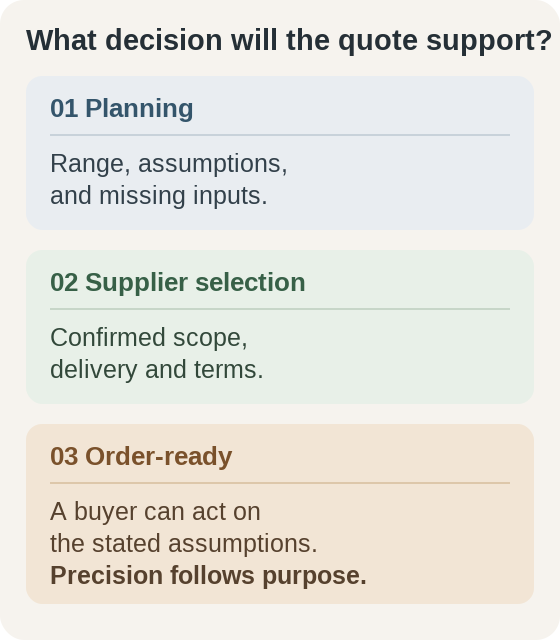
A quote becomes more precise as the buyer’s decision and inputs become clearer.
Name the Decision Before You Name the Price
If the buyer is deciding whether to fund a project, an estimate with a range and explicit assumptions may be more useful than a false sense of precision. If the buyer is choosing between suppliers, the assumptions need to be comparable: same pump configuration, same delivery point, same scope of installation and the same timing basis. If the buyer is ready to order, the remaining uncertainty belongs in the offer rather than in your private notes.
When the Buyer Is Still Planning
Planning conversations often begin before you have a final specification. A public-sector team may speak with suppliers to understand what the market can provide before it writes a procurement strategy. In a private export conversation, you may see the same pattern when a distributor tests whether a new pump category fits a customer project. The request can be real without being order-ready.
A federal procurement example makes the boundary explicit. 48 CFR § 15.201, checked on November 25, 2026, describes an RFI as a way to obtain price, delivery, market or capability information for planning when the government does not presently intend to award a contract. It also says responses are not offers. That rule is not a private-sales contract rule, but it is a useful warning against reading every request for information as a purchase decision.
Build a Useful Estimate Without Pretending It Is Firm
For the pump request, ask what the buyer is trying to decide. If the answer is “Can this project fit our budget?”, give a range or a conditional estimate tied to the pump model, quantity band, delivery country and assumptions you can actually state. Mark what is missing: final flow requirement, installation scope, delivery point or requested date. The buyer receives something usable, and you avoid turning unknowns into invented certainty.
A planning estimate is not a weaker version of a firm quote. It is a different instrument for you and the buyer. Its quality comes from showing which variable would move the number and what question should be answered next. Do not add a fabricated discount, an unconfirmed lead time or a promise that the buyer can place an order on the estimate alone.
When the Buyer Is Comparing Suppliers
Now change the buyer’s job: three suppliers are being compared for the same installation, and the buyer needs to recommend one. Precision becomes worthwhile only after the comparison is fair. Ask for the exact model or performance requirement, the quantity, the delivery address, the required arrival date and which services belong in the quote. Without those inputs, a highly detailed price can still compare unlike scopes.
The federal regulation at 48 CFR § 13.004, checked on November 25, 2026, distinguishes a quotation from an offer in that procurement context. It says a quotation is not an offer that the government can accept to form a binding contract. Private transactions can use different documents and governing terms. The broader discipline is still helpful: label what your document is for, and do not let a buyer or seller infer a commitment that the document does not contain.
For a supplier comparison, show the commercial assumptions next to the price. Is freight included? Which Incoterm basis applies? Is commissioning excluded? Is the delivery date an estimate based on production slot availability? The more a buyer relies on the quote to choose a supplier, the more damaging an unstated difference becomes. A shorter document with visible assumptions can be more decision-ready than a longer document full of unverified detail.
Increase Precision Only When the Inputs Are Comparable
A buyer who cannot confirm the delivery point may still be serious. Do not discard the request simply because one input is missing. Return a clear quote limit: “This figure assumes delivery to the named port and excludes installation; confirm the final site before we firm the freight and arrival date.” That keeps the opportunity alive while making the next required answer visible.
The test is simple: could you explain to another decision-maker what this price includes and what it leaves open? If not, more decimal places will not fix the problem. Ask the missing question or keep the number conditional.
When the Buyer Is Ready to Act
An order-ready quote has a narrower job. The buyer should be able to act on the stated configuration, quantity, delivery point, timing basis, payment terms and validity period. If any of those can still change the economics or feasibility, surface them before presenting the document as firm. The exact list depends on the product and transaction; the principle is stable: the buyer must know which assumptions are now theirs to confirm.
This is where a request for “your final price” can mislead both sides. The word final does not fill in a missing pump duty, a port, a required arrival date or who will install the equipment. Ask what action follows if the number works. Is the buyer selecting a supplier, requesting a pro forma invoice, issuing a purchase order or taking the estimate to an internal approver? The answer tells you which document to prepare next.
For an OKKI Go user, company discovery can help create a candidate list around a product, market and buyer type. It cannot establish that a contact has budget, authority or a confirmed order. Keep the quote decision attached to the evidence the buyer has actually provided. A researched account is a reason to ask a better question, not a reason to send an order-ready promise.
Use three labels in your own pipeline: planning estimate, supplier-selection quote and order-ready quote. Put the buyer’s stated purpose beside the label, then write the single missing input that would move the request forward. If the purpose changes, your document should change with it. If the purpose remains unclear, send a bounded estimate and ask the question that resolves the ambiguity for you both.
Before you send the next quote, write one sentence beginning “The buyer will use this to decide…” Then make every number, assumption and open question serve that sentence.
Frequently asked questions
Is a budgetary quote the same as a firm quote?
No. A budgetary quote supports planning with stated assumptions and unresolved inputs. A firm or order-ready quote requires the scope, delivery basis and commercial conditions needed for the buyer to act, subject to the transaction’s actual terms.
Does an RFQ prove that the buyer is ready to order?
No. A request can support planning, market research or supplier comparison. Ask what decision follows if your price works and what information the buyer has already confirmed.
What should I ask before making an export quote more precise?
Ask for the exact product or performance requirement, quantity, delivery point, required arrival date, included services, freight basis and the action the buyer expects to take next.