Your first B2B customer should give you a credible route to delivering something useful and learning from its use. Account size and reputation matter, but they cannot substitute for an available buyer, a workable evaluation, and obligations your team can meet. A prestigious account can remain a priority without receiving your first delivery slot.

Table of contents
A strong account can still be a poor starting point
You have enough engineering capacity to support one serious customer evaluation. A familiar company name is on the shortlist. Its sites fit your target market, the potential order is attractive, and everyone can imagine what the logo would do for your credibility. Another account looks less impressive but is ready to discuss a specific trial. Which one gets the engineer?
Consider a hypothetical supplier of inspection equipment entering a new export market. A multinational food group has expressed interest, but no plant has agreed to host an evaluation. A regional packaging-line integrator can name the machine it wants to test, the person responsible, and an available test slot. Neither is a customer yet. Both may be relevant. What differs is how much remains unresolved before your work can produce a result.
The food group may be the better account to win eventually. That does not settle whether it is the better place to start. For a supplier with limited delivery capacity, early account selection has to include what the seller can actually support. Here, first customer means the first meaningful deployment in a new business or market, not necessarily the first company to sign a free trial form.
A good profile tells you less than an agreed next step
In his 2013 essay Do Things that Don't Scale, Paul Graham suggests favoring the early users who will sign up sooner over those who might pay most. His rationale includes learning and sales effort. That startup advice is useful here as a question, not a rule to select small companies: which buyer is ready to engage in the work you need to complete?
A prospect can match your industry, geography, and product criteria while lacking an owner for the next action. You may understand its strategic relevance and still know little about its ability to buy, install, or evaluate. Keep that gap visible. Otherwise a strong account profile quietly becomes a promise that your team will have access it has not yet been offered.
Count the work before the customer gets value
Before reserving the engineer, ask what must happen between today's interest and a useful installation. Someone may need to approve the supplier, arrange access to equipment, define a technical test, or accept the result. Then your team must deliver and support what it promised. The time and effort between those events belong in the account decision, even when they do not appear in the headline order value.
A concrete example comes from Siemens Healthineers' US supplier standards page, checked on November 5, 2026. It describes supplier qualification as an initial stage and lists registration, accounts-payable, and electronic-invoicing requirements. The page does not tell us how long a purchase takes. It shows that becoming a supplier involves work beyond an interested contact. Ask your prospective buyer which steps apply to the proposed engagement.
Now look at your side. Can you provide the required installation support without cancelling another commitment? What work must you complete before payment becomes due, and what happens if acceptance is delayed? These are questions for your actual proposal, not assumptions about large companies. A small buyer can also require expensive travel, unusual support hours, or an integration your team cannot maintain.
An easy signature can still produce a poor lesson
The first installation should expose something you need to understand about serving the intended market. A friendly buyer with an unusual setup may approve quickly but teach you little about the accounts you want next. Ask whether you will see the product in a relevant setting, receive usable feedback, and learn what delivery requires. Speed is useful when it gets you to that observation; a signed pilot with no real use gets you no further.
For the inspection supplier, a test on the integrator's representative packaging line could answer a useful application question. A demonstration on an unrelated bench might not. The customer does not have to resemble every future buyer. You do need to explain which part of the experience could transfer, and which part is specific to that account.
Sometimes the larger buyer is the right first customer
Suppose the food group now offers a named plant, an available operating team, and a funded evaluation with a defined scope. The relevant approvals can be addressed, and your supplier team can support the work. Meanwhile, the smaller integrator wants an open-ended demonstration and cannot explain who would buy afterward. The choice may reverse. Company size did not decide it; the conditions for a useful engagement did.
There is also a serious case for investing in a recognized early adopter. In their July 2026 a16z essay Lighthouse or Landgrab?, Joe Schmidt and Julian Marx argue that credible adopters matter where buyers face substantial risk and peer proof influences adoption. They also warn about prestige without reusable learning. Their context is AI-company sales, not industrial equipment; the useful question to carry across is whether this particular success would reduce another target buyer's uncertainty.
That requires more than a well-known name. Would other buyers recognize the application? Could you discuss the implementation or provide a reference with the customer's permission? Are you expecting recognition from a deployment you may not be allowed to describe? These questions do not make reference value unimportant. They make it something to establish before you spend against it.
You may reasonably accept a demanding first engagement when the technical learning or credibility is valuable enough and you can sustain the commitment. Be explicit about that trade-off. Track progress toward the agreed test, acceptance, and support arrangement. A growing number of meetings is a different measure. If the account consumes your available team while leaving those conditions unresolved, prestige is not a substitute for progress.
Choose the first delivery slot, not a permanent winner
Return to the original hypothetical choice: the food group has interest but no agreed trial site; the regional integrator offers a relevant machine and a named test owner. Assume the supplier can meet the integrator's support needs and the commercial scope is acceptable. Under those conditions, allocate the first engineering effort to the integrator. That decision prioritizes an available path to use. It does not declare the food group a bad account or predict either deal's outcome.
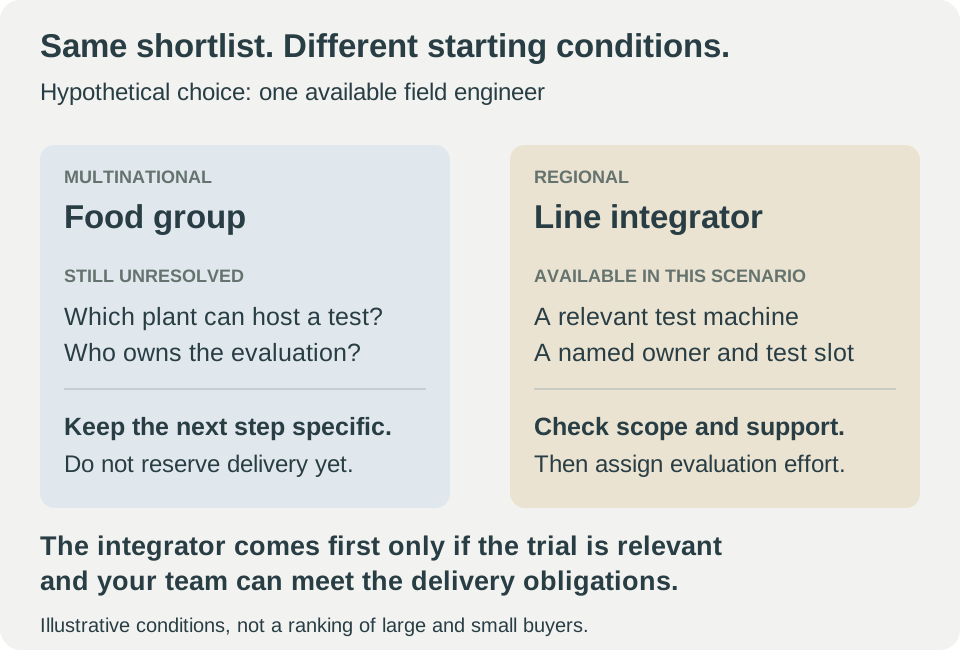
The choice follows the stated starting conditions. Change those conditions and the priority can change.
Give the larger prospect a smaller, specific next step. Ask whether it can identify a trial site and the person who can authorize the evaluation. Agree what your team will prepare while that question is resolved, and avoid reserving an entire implementation schedule against an unspecified future rollout. You can preserve the relationship without treating every conversation as a claim on scarce delivery capacity.
Company research can help you build both parts of the shortlist. OKKI Go's documented use cases, checked on November 5, 2026, describe searches from product context, buyer types, countries, and exclusions, followed by candidate review and user-confirmed unlocking. That gives you companies to investigate. Procurement readiness, trial access, and the effort of serving them still need to be established through the account conversation and your delivery team.
Keep a reason to revisit the order. A funded evaluation, resolved onboarding requirement, or confirmed installation owner may make the larger account ready. A newly discovered support obligation may make the smaller account unsuitable. Recording those conditions lets you change priority without inventing a new strategy every time someone sends an encouraging email.
Before assigning the engineer, ask which customer can put the work to use and what your team must carry to get there. Give that answer more weight than the logo you hope to show later. The other account can stay on the list without taking the first slot.
Frequently asked questions
Should a B2B business always start with smaller customers?
No. A smaller account can still require unsupported customization or offer little relevant learning. Compare the agreed route to use, buyer participation, and your ability to deliver. A large account with a workable evaluation can be a better starting customer than a small account with vague requirements.
What makes a prestigious account worth prioritizing early?
A credible route to a relevant deployment, supportable obligations, and a reason that success there would matter to your intended market. If reference value is part of the case, establish whether and how you can share the experience; recognition alone does not guarantee useful proof.
How can you defer an attractive account without abandoning it?
Keep a specific next action and a condition for renewed delivery investment, such as confirmation of a trial site or completion of a required onboarding step. Limit the resources committed while those conditions remain unresolved, and revisit priority when the evidence changes.