Promise enough to deliver a usable first order, including the support it genuinely requires. Before offering customization, local service or territory protection, establish who will do the work, what it will cost, how long it lasts, and what the buyer contributes. If essential support is beyond your capacity, a smaller promise cannot make the sale workable.

Table of contents
A discount ends with the order. A service promise may not.
The distributor is interested. There is a plausible first order, and your salesperson has a reasonable argument: entering a new country will require some extra effort. But the questions keep coming. Can you translate the software? Train the local technicians? Hold replacement parts? Protect the territory while the distributor builds demand? You may be negotiating the cost of serving a market long before you have priced the first shipment.
A concession on the initial price is visible. You can decide how much margin to give up. An informal promise to provide whatever support is needed is harder to evaluate because its cost depends on what happens later. The commercial mistake is not being generous. It is approving an ongoing obligation as if it were a one-time expense.
Consider a hypothetical exporter of benchtop inspection instruments. Its prospective overseas distributor wants a demonstration unit, training, a translated interface and exclusive rights to a territory. The exporter can supply the instrument and teach a technician to use it. It has not arranged local repairs or costed software maintenance. Saying yes to the entire package would leave several different decisions hidden inside one attractive order.
The extra effort can be worthwhile. Make it visible.
You might deliberately fund a demonstration or an initial training visit because it gives a capable partner a realistic start. That investment can make sense even before the channel is profitable. State the purpose and the cost you are prepared to carry. When the promised service continues after that first effort, identify what keeps paying for it and who remains responsible.
The International Trade Administration's guidance on foreign representative agreements puts training, support and the ability to deliver on schedule beside pricing and payment information. It also asks exporters to address territory and representative performance. Checked on November 6, 2026, the guidance is a useful reminder that the relationship has obligations on both sides. A discounted unit does not resolve those obligations.
Put an operating plan behind the reassurance
Suppose your salesperson says that the instrument comes with local support. What would the customer reasonably expect when it stops working? A remote response, a trained distributor technician, a replacement unit, or a visit from your engineer? These are different services. Before using the same reassuring phrase for all of them, ask the person who would deliver the service what the business can actually provide.
The U.S. Commercial Service's archived Warranties guidance, published in 2016, advises exporters to specify coverage and notes that warranty rights and service expectations differ by country. It is older educational guidance, not a statement of today's law in your destination market. Its commercial question remains useful: does your description of support match the arrangement you are able to operate?
For the hypothetical instrument supplier, a credible first offer could include training a named distributor technician, documenting remote troubleshooting, and agreeing who holds specified spare parts. Those are options to investigate, not a universal service package. If the instrument's application requires an on-site response the arrangement cannot provide, you must build that capability, change the application, or decline the sale.
A pilot does not remove an essential obligation
This is where the buyer's objection can be right. Why should a distributor invest in your product if you refuse the support needed to sell it responsibly? Calling the first shipment a pilot does not make the customer's operating requirements disappear. You may need to invest before receiving a dependable order. The question is whether you understand and can fund that investment, not whether every promise can be postponed.
Customization needs the same treatment. A translated interface involves deciding which version is covered and who maintains it as the product changes. A special configuration needs a definition of acceptance and an owner for future changes. Basecamp's Shape Up method describes setting an investment appetite before a raw idea becomes a project. Applied here, that is an internal budgeting discipline, not permission to reduce a commitment already made.
Ask what the customer is putting behind the request
Territory protection deserves its own conversation. It can ask you to give up access to other partners, while the distributor may need protection to justify training staff, stocking a demonstrator or introducing a new supplier. Either side can have a legitimate concern. Treat the proposed arrangement as an exchange of commitments rather than a reward for being the first company to express interest.
ITA recommends considering a representative's demonstrated capability before granting exclusivity, or considering a limited, defined period. Its guidance also discusses territory and performance expectations. Importantly, it warns that local laws may restrict such arrangements and recommends qualified legal counsel. These are issues to review for the specific relationship and jurisdiction, not a ready-made clause or an assurance that you can end protection whenever you choose.
For this distributor, ask what it will actually put into the launch. Will it assign a trained technician, keep a demonstration instrument, make introductions to relevant users, or take responsibility for an agreed service task? You are looking for actions connected to the requested support. Enthusiasm about the country’s potential does not tell you which side will carry the work after the shipment arrives.
Do the same for your side of the negotiation. If training depends on a named attendee and suitable equipment, establish those inputs before scheduling it. If you need time to confirm software adaptation or replacement-part logistics, say so before giving a delivery assurance. Internal approval is part of making a promise credible; it should not become an excuse to keep the buyer waiting indefinitely.
Build an offer both sides can operate
Return to the hypothetical supplier. Assume a remote-support arrangement is suitable for the initial application, the distributor can assign a technician, and a demonstration instrument can be supplied on acceptable commercial terms. The exporter can now discuss a specific first offer: the instrument configuration, the training, the support available and the distributor's participation. Software localization and a wider territorial arrangement remain separate matters until their scope and costs are resolved.
That distinction should be clear in the proposal, not only in the seller's private notes. A commitment to deliver a defined configuration is different from agreeing to assess an additional request. If the buyer needs the extra feature before it can use the product, that request is a condition of the sale, not an optional item you can quietly leave for later. Resolve the difference before either side relies on a different understanding.
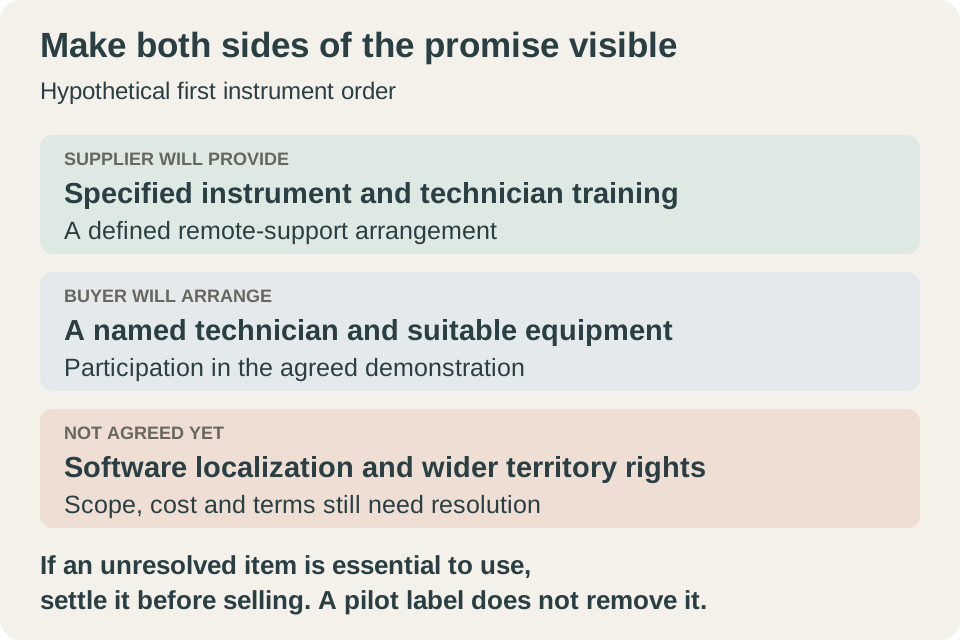
A commercial discussion aid for the hypothetical case, not a contract template or a way to waive required support.
Prospecting research cannot settle these commitments for you. OKKI Go's published use cases describe company searches from product context and buyer criteria, candidate review before selective unlocking, and draft preparation with confirmation before sending. Such research can help identify potential partners. It does not establish whether they will stock parts, train staff or invest in a launch. Those questions belong in the conversation with the buyer and the people who would deliver your offer.
Before asking for the first order, ask your own team what remains to be delivered if the account never grows beyond it. If the answer includes ongoing software maintenance, local service capacity or protection that blocks other opportunities, make those costs part of the decision now. Future volume can be a reason to investigate an investment. It should not be the only explanation for an obligation you are already accepting.
You do not have to make the smallest possible promise to win overseas. You have to make one your business can keep. Fund the extra effort when it has a clear purpose, give the customer an honest description of what it buys, and leave no permanent obligation hidden inside the excitement of the first order.
Frequently asked questions
Should you offer extra support to win your first overseas customer?
It can be a sensible market-entry investment when you understand the work and can fund it. Identify who provides the service, what the buyer supplies and how the arrangement continues after the initial order. Do not sell into an application that needs support you cannot provide.
Should a first distributor receive an exclusive territory?
Evaluate the investment each side is making, the proposed territory and the partner’s ability to develop it. ITA recommends examining capability, duration and performance. The legal effect depends on the specific agreement and jurisdiction; a first order is not enough to settle those questions.
How can you avoid promising unlimited customization?
Distinguish a specified deliverable from a request still under assessment. Clarify the version, acceptance conditions and responsibility for later changes before quoting the work. If the customer cannot use the product without that change, resolve it as a condition of the sale rather than disguising it as a future possibility.