A customer can deserve your attention without deciding what the rest of your business becomes.

Table of contents
The deal on the table and the market in your head
A serious buyer is finally asking detailed questions. They know the application, have involved an engineer, and want a product change before proceeding. Your sales team has a reasonable objection to caution: surely this is the moment to listen? Yes. A concrete conversation is worth investigating. The mistake comes later, when a condition attached to this account becomes an assumption about the market you should pursue.
Consider a hypothetical manufacturer of industrial sensors. A prospective distributor asks for a different connector, a local-language configuration tool, and support for an older control system. The seller starts discussing an export version of the product. Yet those requests might describe one installed system, the distributor's preferred service model, or a requirement shared by an attractive customer segment. The email does not tell you which explanation is right.
These are customer requests: proposed changes from someone with a particular situation. You can take them seriously without accepting the customer's proposed solution as your product plan. First establish what becomes possible if you solve the problem. Would this buyer place an order, run a test, stop using a workaround, or simply prefer your brochure? Each answer supports a different level of commitment from your team.
The requested fix may be larger than the problem
Basecamp offers a useful example in Shape Up. A customer asked for more complex permission rules. Digging into the request, the team found that someone had archived a file without knowing it would disappear for everyone else using the system. They identified a warning on the archive action as a narrower response. This is Basecamp's published account, checked on November 4, 2026, not a case from our customers. Investigate the event behind a request before committing to its proposed remedy.
For the sensor supplier, the equivalent question is what happened on the last installation. Perhaps the connector itself creates a real service problem. Perhaps an adapter would solve it. Perhaps the change would merely make the distributor's catalogue easier to manage. You won't know by debating whether your company should be more customer-focused. You need to understand the job the requested change is supposed to do.
Look for a problem that could travel beyond this buyer
Even after you understand the request, how do you decide whether it belongs in your market strategy? Start with the condition that creates the problem. Companies in the same industry can use different equipment, sell through different channels, and support customers differently. A shared industry label is a starting point for investigation. It is too broad to establish that they would value the same product change.
In the hypothetical example, the useful comparison group might be distributors maintaining the same older control system. It might instead be equipment makers selling into multilingual plants. Those are different hypotheses. If you ask a general list of industrial companies whether a local-language tool sounds useful, polite agreement could leave the central question unresolved: who encounters this problem often enough to change what they buy or how they work?
Ask about the last incident, not the proposed feature
Strategyzer's 2015 guidance on testing a value proposition recommends questions about actual experiences rather than hypothetical opinions. Apply that distinction here. Ask how the last installation was handled, what had to be changed, who did the extra work, and what happened when the workaround failed. Let another buyer describe the problem before showing the solution suggested by the first one. The point is to discover whether the underlying difficulty recurs.
Repeated requests are useful only when you know what is repeating. Several contacts introduced by the same distributor may be responding to one purchasing process. Conversely, buyers may describe the same operational difficulty with different feature requests. Compare the circumstances and consequences, not just the wording. Record the accounts that do not share the problem as well; their differences may tell you where the proposed market ends.
One customer can still be worth the work
There is a strong objection to all this: if you wait for a pattern before helping anyone, you may never learn enough to recognize one. An early customer who lets you see the problem closely can be more useful than a large collection of general opinions. A business with few customers cannot demand certainty before every useful experiment. Sometimes you have to work with the person who is willing to let you in.
Paul Graham makes that case in his 2013 essay Do Things that Don't Scale. He advises some B2B startups to work exceptionally closely with a single early user and shape the product around what they learn. He also draws a distinction between that attention and being paid by the hour to meet a customer's consulting demands. His argument is a reason to engage deeply, not evidence that every bespoke specification identifies a new market.
You can make a separate commercial decision to take a custom order. Suppose the sensor buyer will fund the work, the acceptance criteria are clear, and your team can support the variation without disrupting commitments already made. That project may be worthwhile even if nobody else ever buys it. Call it a custom project and account for its obligations. You don't need to describe it as a strategic breakthrough to justify doing it.
A learning partnership has a different return. You might accept limited extra effort because the buyer provides access to a real installation, the people who use it, and a concrete evaluation process. Ask what you expect to learn, how much effort you are willing to invest, and when you will reconsider. A vague promise of future volume gives you little basis for deciding whether that learning is worth the cost.
What should count as commitment? Strategyzer's 2017 discussion of innovation evidence distinguishes quick exploratory interviews from evidence closer to actual buying behavior. For this decision, examples might include access to the relevant team, agreed test conditions, an allocated evaluation slot, or a funded pilot. These are proposed signals to examine, not equivalent proof of demand. A buyer may be unable to pay before qualification; a scheduled technical evaluation can still justify a bounded next step.
Be explicit about what you are approving
Return to the sensor request. Assume you have established that the connector change solves a real installation problem for this distributor. The configuration tool is still a preference, and compatibility with the older control system remains untested. Nothing in that record yet establishes demand across the whole export market. You can approve investigation of the compatibility problem without also approving a new product range and a permanent support promise.
Make the next decision small enough to explain. A custom project needs a deliverable, commercial scope, and support responsibility. A learning experiment needs a question, access to useful evidence, and a limit on effort. A market bet needs a stronger argument that a reusable capability matters to a defined group of buyers and that the business can reach and serve them. One conversation can start all three discussions, but it cannot settle them on its own.
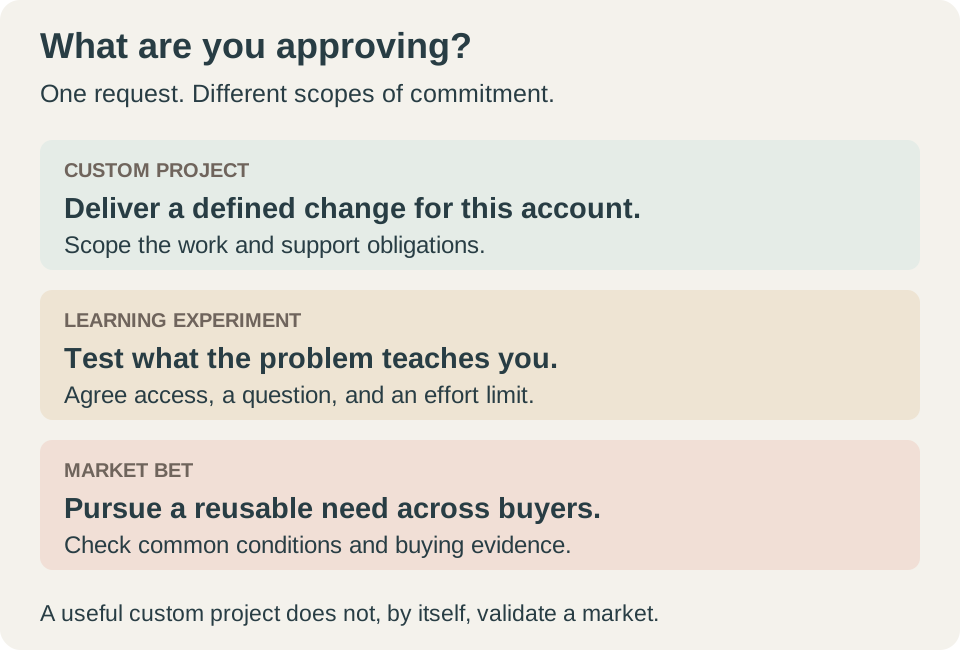
The same request can justify work at different scopes. Evidence for one scope does not automatically establish the next.
Basecamp's appetite concept is helpful here: decide what attention an idea deserves before allowing the proposed solution to define the project. For the manufacturer, that could mean evaluating one connector variation while leaving the software request outside the first commitment. If the test reveals a wider problem, reconsider the scope explicitly. The discovery should reopen a decision, not silently expand an existing promise.
Finding comparable companies can support that investigation. OKKI Go's documented workflow accepts product context, buyer types, markets, and exclusions, then returns company candidates for review before selective unlocking. It can help you assemble a group to investigate. The reasons those companies appear in a search are not evidence that they share the original buyer's problem. That evidence still has to come from their operating circumstances and what you learn from them.
What would make you change direction? Write that down before the pilot becomes a success story. Perhaps unrelated buyers describe the same costly workaround, a common technical condition explains it, and they take credible steps toward evaluating a reusable solution. Those findings would justify revisiting the market hypothesis.
For the sensor supplier, the next commitment might be a connector prototype and an agreed evaluation, with no promise of a new product range. If the evidence remains specific to this account, finish that project on its own terms. You can leave the broader market strategy unchanged.
Frequently asked questions
Should a supplier change its product for one customer?
Yes, if the value of serving that account justifies the delivery and support obligations. Be clear whether the customer is paying for a defined deliverable or helping you investigate an unresolved problem. The agreement should make that purpose clear to both sides.
How do you tell a customer request from a market need?
Investigate the problem behind the proposed solution and the conditions that cause it. Look for comparable buyers encountering that problem independently. Similar company profiles or repeated feature wording alone are weak grounds for assuming that the same capability will matter across a market.
Must every early customer pay before their feedback matters?
No. Access to a real use case, relevant users, test conditions, or an agreed evaluation can justify a limited learning investment. Decide what that participation can establish. Enthusiasm and detailed feedback still do not demonstrate that a broader group will buy.