Before answering “your price is too high,” establish what the buyer is comparing: the same usable package, a different delivery or service scope, a spending limit, or a benefit it does not need. Then decide whether to clarify the offer, change genuine optional scope, negotiate within your economics, or stop. A cheaper acceptable offer can be a rational choice.

Table of contents
Before changing the number, establish the offer
“Your price is too high. Another supplier can do it for less.” You have a reply to send, a margin to protect and a reason to keep the conversation moving. A discount is easy to put on the page. So is another paragraph about quality. Neither tells you yet what the buyer is comparing.
Consider a hypothetical exporter quoting a compact dosing pump to an overseas manufacturer. Your offer includes the pump, a controller and a connection kit. Delivery is quoted to an agreed destination. The buyer mentions a cheaper alternative, but you don’t know which accessories or delivery arrangements it includes. No actual supplier, price or completed order is represented in this example.
Your first useful question is narrow: “Are you comparing the pump alone, or the package supplied to the delivery point we’ve quoted?” You are checking what the prices describe. There is no need to challenge the buyer’s competence or ask for a competitor’s confidential proposal. A description of the relevant scope may be enough to establish what needs checking.
The U.S. International Trade Administration’s Pro Forma Invoice guidance, checked on November 11, 2026, treats a pro forma invoice as a quotation in invoice format. Its information list includes the items, unit prices and totals, terms of sale and delivery point, payment terms, estimated shipping date and validity date. A headline unit price leaves much of that comparison unresolved.
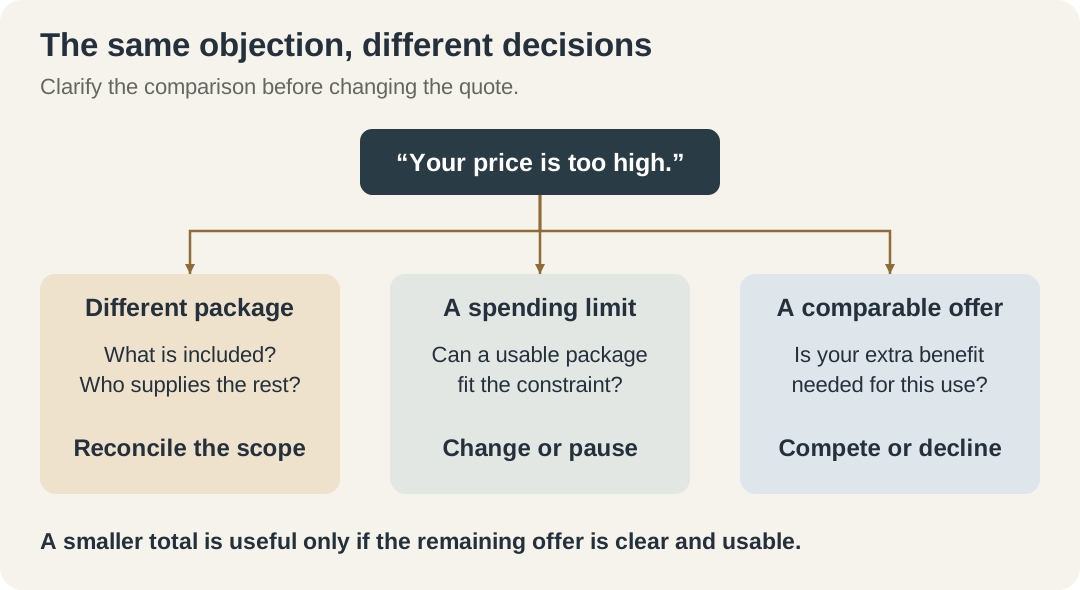
Illustrative decision branches, not measured buyer behaviour or a prescribed negotiation sequence.
Delivery scope can change what the price describes
In its Determine Total Export Price guidance, checked on the same date, ITA includes goods, shipping, insurance, tariffs, taxes and other fees in landed cost, and says the resulting figures should be treated as estimates. These are U.S.-export educational references, not a live freight quote or a rule assigning charges in your deal. Use the distinction to clarify who is providing and paying for what. Don’t invent a delivered total simply to make your quotation look cheaper.
Let the next reply change what you do
Now keep the product the same and change what the buyer tells you. The following exchanges are alternative hypothetical situations, not stages every negotiation must pass through. A scope mismatch, a spending limit and a cheaper acceptable alternative call for different decisions.
“That price is for the pump only.”
The buyer says it already has a compatible controller and will arrange collection. You can review a pump-only option, provided compatibility and responsibilities are established. The revised offer needs to show what has been removed, its delivery basis and what the customer will supply. You haven’t demonstrated that either supplier is cheaper on equal terms yet. You have identified a different purchasing package.
If the controller is necessary and the buyer cannot provide a suitable one, taking it off the quotation only hides an unresolved cost. Keep the complete requirement visible, even if the resulting total is harder to sell.
“We need the complete package, but the budget won’t cover it.”
This buyer accepts the scope and still cannot fund the purchase. Ask whether the ceiling applies to the total commitment or to what can be paid now. That distinction may open a discussion of a genuine scope change, revised timing or payment terms your business can actually support. It does not entitle you to assume that financing is available or that a future budget will be approved.
If the minimum usable package is still beyond the ceiling, a stronger value explanation may leave the constraint unchanged. A pause can be the correct answer. You shouldn’t remove a necessary component and leave the buyer with an apparently affordable product it cannot use.
“The other offer includes the same things, and it is enough.”
The buyer now describes a genuinely comparable offer: the required configuration, an acceptable delivery arrangement and terms it can work with. It also says that the competing product meets the application’s needs. You don’t have access to the rival’s internal costs or the buyer’s private evaluation, so treat that description as something to clarify, not evidence that the competitor must be cutting corners.
You may have a real difference worth discussing. Identify it precisely and ask whether it matters for this purchase. If you claim that your equipment reduces operating expense, show the basis and the conditions under which the claim holds. Without that evidence, a promise about lifetime savings is just another unsupported number waiting to be challenged.
But the answer may be that the extra capability has no useful role here. The buyer doesn’t need the more flexible configuration, or the service difference isn’t relevant to the arrangement it plans to use. If both offers satisfy the requirement and yours costs more, the buyer has a coherent reason to prefer the cheaper one. Another presentation about your company won’t necessarily alter it.
ITA’s Pricing Strategy guidance, checked on November 11, 2026, puts costs, market demand and competition beside the exporter’s market objectives. It also recognises that cost-plus pricing can become uncompetitive once export costs are added. The guidance does not establish your margin or your rival’s price. It does support looking beyond the fact that you have costs to recover: those costs alone don’t decide whether the buyer should pay your quotation.
A discount can be a deliberate commercial choice
You can still decide to reduce the price. There may be room within your approved economics, or a different quantity or delivery arrangement may support a different offer. State the real basis of that change. Don’t invent a “special approval” deadline, and don’t imply that a concession proves the buyer misunderstood the original value.
If an acceptable price would fall below what your business can support, the decision may be to decline. Clarifying the comparison is not a technique that makes every deal winnable. Sometimes it shows you why the deal belongs elsewhere. That is useful information before you commit more time or promise an exception you cannot sustain.
Return a clearer choice, not just a smaller total
Before you send the next version, name the change you are making. Are you correcting unlike delivery scopes, removing an optional item, changing a commercially workable term, or reducing the price of the same package? The buyer should be able to tell which decision is on the table without reconstructing the conversation.
Return to the hypothetical pump quotation. Suppose the buyer has suitable control equipment and asks you to supply the pump with the connection kit, for collection under clearly agreed arrangements. Those are scenario assumptions, not facts about a real customer. You revise the scope accordingly and leave the omitted controller visible as an exclusion. Any remaining delivery and payment responsibilities still need agreement. The revised total now describes a different offer; it is not evidence of a successful discount strategy.
The useful result at this point is a comparison the buyer can understand: what it receives, what it supplies itself and which costs remain outside the quotation. No sale has been demonstrated. If the buyer then confirms that an equivalent offer remains cheaper, you are back to a competitive price decision. If the buyer says even this version exceeds the budget, you are dealing with affordability. Don’t keep answering the first question after the reply has changed it.
You may reach this conversation through OKKI Go, an exhibition or a referral. The source of the account does not reveal its private budget or what another supplier has promised. Keep those unknowns in the conversation rather than filling them with assumptions. The next quotation should expose the actual trade-off, including the possibility that no workable offer exists today.
Send the next quote only when you can explain what has changed and what decision it enables. If the scope is different, show it. If the budget is binding, respect it. If the comparable alternative is cheaper and sufficient, decide whether you can compete. You don’t need to turn every honest price difference into a persuasion problem.
Frequently asked questions
What should you ask when a B2B buyer says your price is too high?
Ask what offer or constraint the buyer is comparing with your quotation. Confirm the required configuration, quantity, delivery basis and any relevant payment terms without demanding confidential competitor documents. A different package, a hard spending limit and a cheaper equivalent offer require different next steps.
Should you discount an export quotation after a price objection?
A discount can make commercial sense after the scope and relevant terms are clear and the revised economics are acceptable to your business. It should not conceal missing components or unresolved delivery costs. If an affordable, usable offer is not possible, postponing or declining the opportunity can be appropriate.
How can you compare quotations with different delivery scopes?
Identify the delivery points, included services and responsibilities, then establish which costs sit outside each quotation. Use current information for any estimates you prepare. A product-only price and a delivered package total cannot establish who is cheaper without that context; neither figure proves the other supplier is misleading the buyer.